
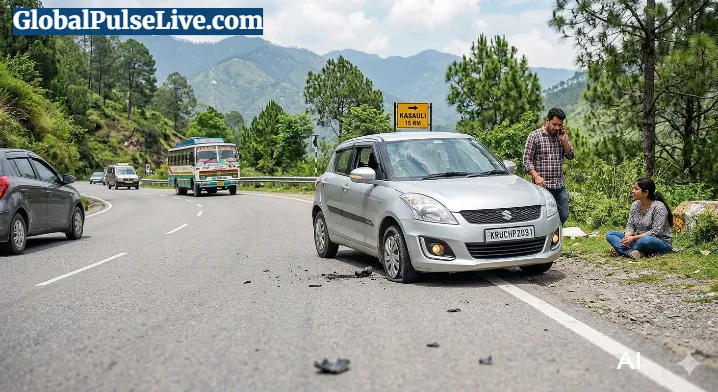
There are many misfortunes we quietly assign to other people.
A tyre burst on a highway is one of them. It belongs, in some private corner of the subconscious, to strangers in news reports, to unnamed motorists on long, indifferent stretches of road. It is not supposed to belong to someone who rarely drives, who prefers the stillness of home, who exists mostly as a passenger in the world of motion. In that quiet internal taxonomy of risk, it simply does not file under self.
But misfortunes do not respect categorisation.
For instance, you die. How inconvenient. And if death must arrive, it often insists on a narrative. Why not something as mechanically absurd, as bluntly random, as a tyre burst on a highway?
It was a 155/80 R13 tyre, if such details matter in the aftermath of shock. Small, almost modest—at least when compared to the oversized wheels of modern SUVs like the Mahindra Thar or Toyota Fortuner that dominate India’s highways. It belonged to a Nissan Micra. Our Micra.
Here is the scene as it was before the moment split time into “before” and “after.”
My wife is driving. I am in the front passenger seat. My mother and younger brother are in the back. If one were to describe it with full emotional accuracy, it would be simpler to say: my entire world is inside this small moving box of metal and glass.
We are in good spirits. It is late October, the air already hinting at winter in North India. We are travelling for a family engagement—a cousin’s ceremony at a resort near the Punjab–Himachal border. The engagement is an excuse layered over something better: a three-day stay in Kasauli, a hill station that promises slow mornings, pine-scented air, and a break from the flat insistence of plains life.
We begin the journey from Muzaffarnagar, where my mother lives. The highway opens itself in long, familiar stretches. We pass Deoband, gliding over a flyover from which, briefly, the domes and minarets of a grand mosque appear to our left—quiet, dignified silhouettes against the sky. The road continues past Saharanpur and Jagadhri, towns that blur into one another in the rhythm of distance and asphalt.
It is somewhere after Jagadhri that the injury occurs.
Not an accident in the cinematic sense. There is no dramatic swerving, no visible catastrophe unfolding in slow motion. It is sharper than that, and therefore more unsettling: a sudden shift in the car’s behaviour, a sound that does not belong to any safe vocabulary of travel, a change in the road’s relationship to the vehicle.
A tyre has burst.
What follows is not panic, at least not immediately. First comes disbelief, the mind trying to negotiate with physics as if it were a misunderstanding that can be resolved through attention. Then comes the road, still moving, still indifferent, still stretching forward as if nothing has changed.
Inside the car, everything feels smaller. The space between four people becomes a single shared thought: stay steady.
And perhaps that is what highways do best—they reveal how quickly control is an illusion, how thin the boundary is between routine travel and sudden interruption.
Eventually, the car is brought to a halt. The world outside remains unchanged: trucks pass, buses roar by, and distant vehicles continue their uninterrupted faith in their own stability. The tyre, however, is no longer part of that agreement.
What lingers afterwards is not the burst itself, but the strange clarity it leaves behind. The knowledge that everything assumed to be “only what happens to others” is, in fact, part of the same road we all travel. It does not ask for permission. It simply arrives.
And then, as always, the journey continues—just slightly rewritten.