
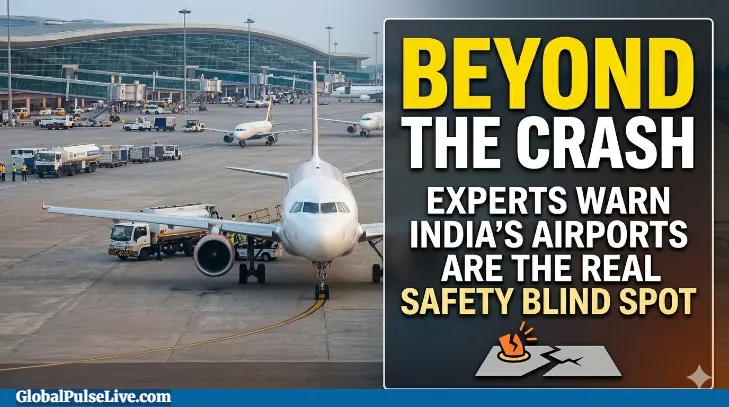
The June 12, 2025, air crash involving an Air India Boeing 787-8 Dreamliner in Ahmedabad has once again pushed aviation safety into the national spotlight. But for many in the industry, the focus on aircraft systems alone misses a larger, more persistent concern.
Air safety experts argue that India’s airports themselves—often celebrated for modern terminals and expanding capacity—are carrying unresolved structural risks that receive far less attention than they deserve. From encroachments in critical flight paths to inadequate navigation infrastructure and unchecked environmental hazards, they say the vulnerabilities are both systemic and longstanding.
“Safety is not just in the sky, but on the ground”
“It is time to look comprehensively at all aspects of safety,” said Captain G.R. Gopinath, former Indian Army officer and founder of low-cost carrier Air Deccan, whose operations once reshaped regional aviation out of Ahmedabad.
He warned that airport safety in India is undermined by a combination of planning failures and weak enforcement.
“Encroachments and development with permission granted by local authorities on either side of the runway, and lapses in internal safety measures, bird menace because of garbage dumping just beyond the airport’s perimeter, in the approach and take-off path, are all major issues which require attention,” he said.
Gopinath pointed to what he called a persistent imbalance in infrastructure spending. While metro airports receive significant investment in terminals and passenger amenities, the “air-side” infrastructure—runways, navigation systems, lighting, and safety buffers—often lags behind.
He cited past incidents in smaller airports, including cases where construction in approach funnels compromised safe landing paths. “No-objection certificates should never be given for structures that intrude into flight paths,” he said.
He also highlighted a structural mismatch in priorities: “What normally comes to mind when you say ‘airport’ is the building. But aircraft safety depends far more on what happens outside the terminal.”
According to him, smaller airports remain critical for India’s connectivity model. “India still lives in its villages. Rural areas must be connected to hubs. That requires functional, low-cost airports—not just architectural showcases.”
He argued for investment in basic operational safety systems such as runway lighting, navigation aids, and parallel taxiways. “Many flights return because they cannot land in poor weather due to inadequate landing support systems,” he said.
The “funnel zone” problem and ground-level risks
Experts also point to growing hazards around airport approach paths—often referred to as the runway “funnel”—where obstacles or buildings can interfere with safe landing trajectories.
“The runway funnel has to be cleared,” Gopinath said. “If those buildings were not there right in front of the runway, the pilot could have attempted a clear landing.”
A recurring concern is also the rising bird activity around airports, frequently linked to unmanaged waste disposal near airfields. Such conditions, pilots say, increase the risk of bird strikes during critical phases of flight.
“One more accident will hardly make a difference”
Former airline instructor-pilot and aviation safety adviser Captain A. Mohan Ranganathan offered a more pessimistic assessment of regulatory responsiveness.
He argued that many of India’s safety concerns have already been identified in past reports but remain unaddressed.
“One more accident will hardly make a difference,” he said, pointing to what he described as institutional inertia.
Ranganathan identified the Kozhikode Airport (Karippur) and Mangaluru Airport as particularly concerning, arguing that their operational constraints make them unsuitable for certain categories of aircraft without major upgrades.
In earlier communications to aviation regulators, including the Directorate General of Civil Aviation (DGCA), he had flagged risks associated with runway conditions, safety margins, and landing procedures under adverse weather conditions.
He specifically cited deficiencies in Runway End Safety Areas (RESA) and runway width compliance with international standards, warning that these gaps increase risk during overshoot or landing deviations.
Despite repeated recommendations, he said corrective action has been limited. In his view, some airports may require operational restrictions rather than incremental upgrades, including limiting aircraft size or redirecting traffic to nearby safer facilities.
Structural reform, not incremental fixes
Both experts converge on one point: the need for systemic reform rather than isolated interventions.
They argue that India’s aviation safety framework must move beyond reactive responses following accidents and instead enforce strict compliance with zoning laws, environmental management around airports, and infrastructure standards aligned with international aviation norms.
The proposed direction includes clearing encroachments in flight paths, strengthening regulatory enforcement against unauthorized construction, improving perimeter security, and investing in navigation and landing systems at smaller airports.
Above all, they stress that safety cannot remain a post-incident conversation.
As Ranganathan put it, meaningful change will require “immense political will,” with regulators asserting authority even when it conflicts with local development pressures.
Until then, experts warn, the most vulnerable point in aviation may not be the aircraft in the sky—but the ground it depends on to land safely.