

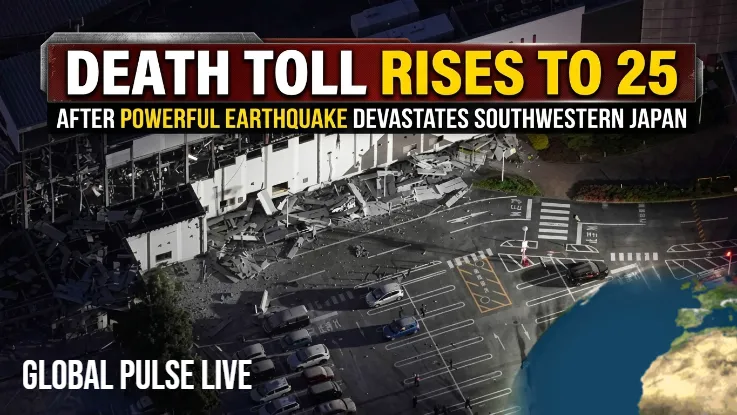
Kumamoto, Japan: Rescue teams continued an intense search for survivors across Japan’s Kumamoto Prefecture on Thursday, two days after a powerful 7.1-magnitude earthquake struck the country’s southwestern Kyushu region, killing at least 25 people, injuring dozens more, and leaving widespread destruction in its wake.
Authorities said time was running out to locate survivors trapped beneath collapsed buildings as emergency personnel worked around the clock in some of the hardest-hit communities. While 25 deaths have been officially confirmed, officials are also investigating nine additional fatalities that may be linked to the disaster. At least 86 people were injured, including five who remain in critical condition.
Thousands Remain Displaced
The earthquake caused extensive damage to homes, public infrastructure, and essential services, forcing thousands of residents to seek refuge in emergency shelters. More than 9,000 people spent another night in nearly 400 evacuation centers, while around 19,000 households remained without electricity. Several communities also continued to face disruptions to water supplies.
Many residents have been reluctant to return to their homes due to repeated aftershocks and concerns over structural damage. Others have been forced to sleep in their vehicles or temporary shelters because their homes are no longer safe.
Heatwave Raises Health Concerns
As recovery efforts continue, officials are increasingly concerned about the risk of heat-related illnesses. Japan’s Ministry of Environment issued a heatstroke alert for the Kumamoto region, where temperatures were expected to climb to 33°C (91°F) on Thursday.
Medical teams have been deployed to monitor the health of evacuees, particularly elderly residents and those with existing injuries.
“We must ensure that elderly people do not suffer from dehydration or heatstroke while staying in evacuation centers,” said Dr. Yutaka Kobayashi, who was dispatched from Aichi Prefecture to assist local authorities.
Residents Struggle Without Basic Services
In the town of Hikawa, one of the areas worst affected by the earthquake, many residents remain without electricity or running water.
Sixty-six-year-old resident Yoshiaki Nakashima said he has chosen to sleep in his car rather than stay at an evacuation center or return home, fearing strong aftershocks.
“It’s difficult to sleep in a car, but I still feel safer than returning home,” he said while collecting bottled water distributed by local authorities.
Another resident, Akiko Inazaki, has been living in a tent outside her damaged home since the earthquake. With water supplies scarce, she said every drop has become precious.
“Fresh water is extremely valuable,” she said, adding that she nearly suffered heatstroke because she had been limiting her water intake.
Local officials also warned that emergency food supplies, including canned bread and instant rice, are beginning to run low in several evacuation centers.
Mall Explosion and Factory Collapse Cause Heavy Casualties
The most severe destruction occurred at the Aeon Mall in the town of Kashima, where approximately 3,000 shoppers were evacuated moments before an explosion rocked part of the shopping complex following the earthquake.
The blast caused the mall’s second floor to collapse, trapping several workers and shoppers inside. Authorities confirmed that six people have died at the mall, while rescue teams continue searching through the debris.
In the nearby Yatsushiro area, a massive chimney collapsed at a Nippon Paper Industries factory, killing eight workers. Rescue personnel managed to save ten people, while one individual remains missing.
Government footage showed emergency responders drilling through collapsed concrete and twisted steel in an effort to reach anyone still trapped beneath the rubble.
Government Intensifies Relief Efforts
Japanese Prime Minister Sanae Takaichi said the central government is coordinating nationwide rescue and relief operations to accelerate recovery efforts.
She emphasized that restoring electricity, water, gas supplies, and ensuring access to clean drinking water remain the government’s top priorities.
“The needs on the ground are constantly changing. To ease people’s anxiety and uncertainty, the government will do everything necessary to support those affected,” the Prime Minister said.
Rescue teams continue to race against time as aftershocks and extreme heat complicate recovery efforts across the disaster-stricken region.