
We are often told that the journey is what matters. Perhaps that was true when travel meant sailing ships, caravans of camels, horseback crossings, or elephants moving slowly through forests and kingdoms. But in the modern age of airports, buses, baggage checks, and immigration lines, what truly matters are the destinations.
The travelogue itself feels increasingly like an anachronism. Few people remember — or even want to remember — the actual process of getting somewhere. Who wishes to relive the endless queues, the X-ray scanners, the ritual humiliation of removing shoes and belts, the overpriced airport meals, the bloated exhaustion of long-haul flights, or the anxiety of cancellations and delays? The mechanics of travel fade quickly. What endure are the places.
Or, more accurately, what endure are the stories we attach to those places.
Memory rarely preserves a city as a complete image. Instead, it keeps fragments — sensory impressions stitched together with conversations, emotions, accidents, and associations. Every traveller becomes an annotator, layering personal meaning onto streets, buildings, meals, and encounters.
My own visit to Istanbul in late April 2016 was, in an oddly literal sense, about annotations themselves — not in the mind, but on the web.
Suzan Üsküdarlı, a professor at Boğaziçi University in Bebek, had invited a mutual friend, Kavita Philip, then a history professor at the University of California, Irvine, to participate in a workshop focused on developing annotation tools for digital spaces. The gathering carried the clever title “AnnotateIST” — a fusion of “Annotate” and “Istanbul” — and unlike many academic conferences, it possessed an unusually direct and practical mission.
“The intention of this gathering,” the organisers wrote, “is to bring together people who have been working on annotation frameworks and those who see the potential in annotating web documents. We aim to model a space and a form of technological practice, in an experimental collaborative workshop.”
The language sounded academic, even abstract, but the underlying idea was surprisingly human: how do we collectively add meaning to information? How do we leave traces of interpretation, disagreement, memory, and context in digital spaces increasingly designed for speed and forgetting?
In retrospect, the conference mirrored the city hosting it.
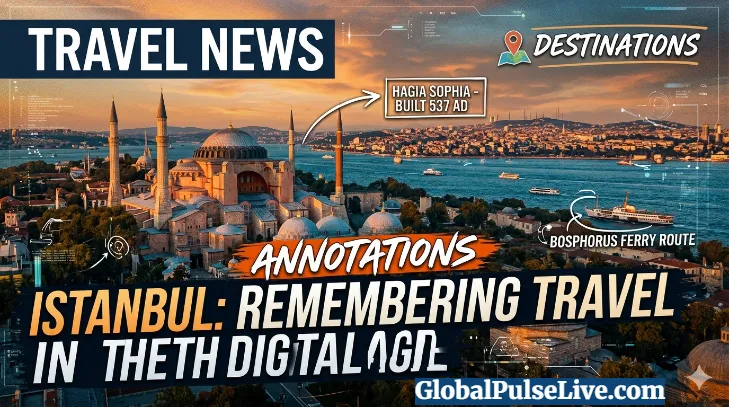
Istanbul itself feels like a vast annotation layered upon history. Every district carries footnotes from empires: Byzantine, Roman, Ottoman, modern Turkish. Churches become mosques, mosques become museums, and museums become political arguments. Streets are rewritten by memory and power. The city resists singular interpretation.
Walking through Bebek along the Bosphorus, one sensed this accumulation constantly. Fishermen stood beneath Ottoman facades while students hurried toward university buildings carrying smartphones and takeaway coffee. The call to prayer drifted across waters crowded with ferries and cargo ships moving between continents. Europe and Asia were not abstractions there; they were visible shores.
And like all memorable destinations, Istanbul ultimately survives in recollection less as geography than as annotation.
I do not clearly remember the flights that took me there, nor the airport procedures, nor the transit lounges blurred by fatigue. Those details vanished almost immediately. What remains are flashes: tea beside the Bosphorus, conversations about technology and memory, the steep streets descending toward the water, the uneasy political atmosphere lingering in the months before Turkey’s failed coup attempt later that year.
Travel, in the end, may not really be about movement at all. It is about meaning-making. Destinations endure because we turn them into narratives — because we annotate them with our own experiences.
And perhaps that is why certain cities remain unforgettable long after the journey itself has disappeared.