
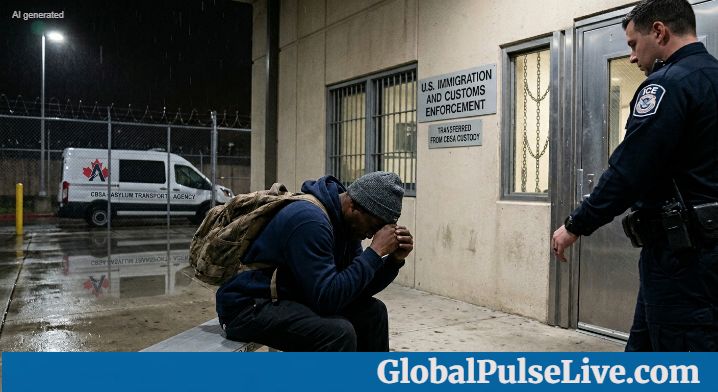
Canada – In a US immigration detention facility, 25-year-old Haitian asylum seeker Markens Appolon says each passing day feels like the life he hoped to build is slipping further out of reach.
Appolon left Haiti in 2023 after escalating gang violence disrupted his university studies in economics and destabilised daily life across the country. Like many others displaced by the crisis, he first sought safety abroad and eventually made his way to the United States, where he lived in Florida with an uncle under a humanitarian parole programme introduced during the Biden administration.
His plan, he says, was never to stay permanently in the US. With family in Montreal and a belief that Canada would offer protection, Appolon intended to seek asylum there instead.
But for the past four and a half months, he has been held in a US Immigration and Customs Enforcement (ICE) facility after being turned back at the Canadian border and transferred into US custody.

“Every day that passes, my mental health is just getting worse. You see the world going on and you’re just stuck here, watching,” Appolon said. “I’m here, and even when I get out, the problem is going to be worse.”
His case has drawn attention from Canadian immigration lawyers, who argue it highlights growing strain and rigidity in cross-border asylum processing between Canada and the United States under the Safe Third Country Agreement.
“This is what is so shocking about this case and others like it,” said Erin Simpson, a Toronto-based immigration lawyer representing Appolon. “Canada is participating in this. Canada is handing people over to ICE.”
The agreement between Canada and the US requires asylum seekers to request protection in the first “safe” country they arrive in, with limited exceptions—often including cases where applicants have close family in Canada. Critics argue those exceptions are being applied too narrowly.
Simpson and other lawyers say similar cases have increased since the start of US President Donald Trump’s second term, as shifts in US immigration enforcement and the tightening of Canadian asylum rules have left more claimants in legal limbo.
Appolon reached the Quebec–Vermont border on 28 December intending to claim asylum in Canada. His aunt, a Canadian citizen, was abroad at the time due to a family emergency, and border officials reportedly determined that without her physically present in Canada, he did not qualify for the family exception.
He was refused entry and transferred to ICE custody.
According to Simpson, Canadian officials could have exercised discretion, allowing time for his aunt to return. Canadian legislation does not explicitly require that a relative be physically present in Canada at the moment of claim, she said.
Canada’s federal government, now led by Prime Minister Mark Carney, has recently introduced new legislation tightening eligibility rules for asylum seekers—changes critics say risk increasing refusals and administrative barriers at the border.
Officials maintain that the system remains fair and necessary to manage asylum flows. Immigration, Refugees and Citizenship Canada says the Safe Third Country Agreement is an “important tool for the orderly management of asylum claims” and that the United States is regularly monitored to ensure it meets human rights obligations.
For Appolon, the policy debate feels distant compared to daily life inside detention.
“I’m here, and even when I get out, the problem is going to be worse,” he said.
Another asylum seeker, Tenzin, a refugee from Tibet, described a similar experience after attempting to enter Canada from the US in August. He had family waiting in Toronto but was instead detained by ICE and held at a facility in Buffalo, New York.
Over months in detention, Tenzin’s health deteriorated. By December, he began losing movement on one side of his face. After repeated requests for medical attention, he was taken to hospital and diagnosed with Bell’s palsy.
His lawyer, Ottawa-based immigration attorney Heather Neufeld, said Tenzin’s case reflects how procedural decisions at the border can have severe human consequences, particularly for stateless or undocumented refugees.
Neufeld later successfully challenged aspects of his detention and identity verification process, leading to his release in February. He has since joined family in Toronto.
A third case, involving Gurbir Singh, further underscores what lawyers describe as inconsistent application of border rules. Singh says he fled India after receiving threats from police and attempted to claim asylum in Canada in March, planning to reunite with relatives in Brampton.
Despite presenting identification and biometric data, Canadian border officials initially questioned his identity and transferred him to ICE detention. He was later released after legal intervention and allowed to enter Canada in April.
Simpson says such cases illustrate a growing rigidity in how exceptions to the Safe Third Country Agreement are applied.
“I’ve certainly never seen that,” she said. “We are seeing a real rigidity in the exceptions at the border and a real failure to recognize the extraordinary cost of erroneous decision making.”
Legal experts, including University of Toronto professor Audrey Macklin, argue that Canada could accommodate more asylum seekers arriving from the US but is instead tightening its system in response to political pressures and anticipated increases in applications.
“[Canada] constantly intones how generous it is to refugees,” Macklin said. “But clearly, there’s no political will there.”
The Canada Border Services Agency (CBSA) said it cannot comment on individual cases, citing privacy rules, but stated that officers assess eligibility impartially and require evidence that family relationships meet legal thresholds. It added that decisions can be reconsidered in exceptional circumstances.
US Immigration and Customs Enforcement did not respond to requests for comment.
For Appolon, who remains detained in the US, the outcome of these policy debates will determine whether he can rebuild his life—or whether his attempt to find safety will end in prolonged confinement far from the future he once imagined.