
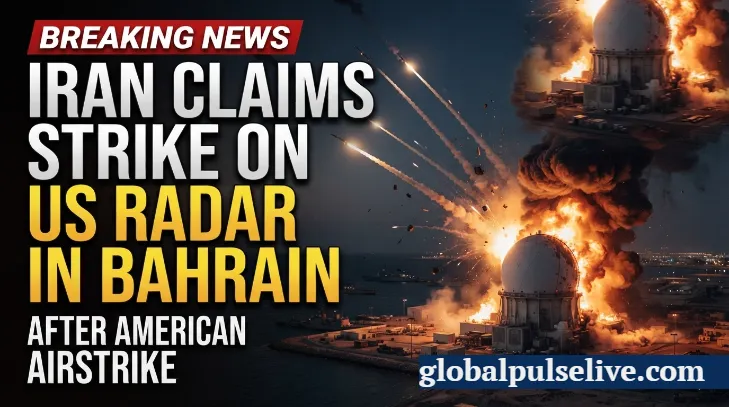
Iran has claimed responsibility for striking a US military early-warning radar in Bahrain, marking what it describes as its first direct attack on American military installations in several months. The action was announced by Iran’s Islamic Revolutionary Guard Corps (IRGC), which said the strike was carried out in retaliation for a recent US airstrike on a communications tower in Sirik overlooking the strategic Strait of Hormuz.
In a statement, the IRGC said the operation was intended as a “serious warning” to the United States, accusing Washington of conducting aerial provocations and facilitating oil smuggling in the Strait of Hormuz. The force warned that any further attacks or violations would be met with an unrestricted military response, adding that its aerospace units remain on full operational alert.
However, the United States Central Command (CENTCOM) disputed Iran’s claims, stating that the radar installation in Bahrain had not been destroyed. According to the US military, American forces intercepted two Iranian drones that were heading toward Bahrain before they could reach their targets.
The latest exchange has heightened concerns over a broader regional conflict, even as former US President Donald Trump indicated he would authorize military action against Iran only if absolutely necessary. Speaking in a series of interviews, Trump said Gulf allies, including Saudi Arabia, had urged restraint and advised against launching large-scale strikes on Iran.
Trump also revealed that he had instructed Vice President JD Vance to abandon efforts aimed at negotiating a new agreement with Tehran and instead concentrate on domestic issues, including corruption and fraud investigations in Democrat-led states and cities. Vance had reportedly been viewed by Iranian officials as one of the more credible figures within Trump’s circle, but Tehran is said to have rejected his request for direct talks with Iranian negotiators.
Meanwhile, public opinion in the United Kingdom appears strongly opposed to another military conflict involving Iran. A recent YouGov survey conducted for the Council for Arab-British Understanding (Caabu) found that 65 percent of respondents opposed the United States resuming military operations against Iran, while only 14 percent supported such action. The survey also showed that a majority opposed allowing UK military bases to be used for US attacks on Iran, although nearly half of those surveyed backed additional sanctions on Tehran.
Adding another layer of uncertainty, Iran’s Assembly of Experts has called for a review of the country’s defence doctrine and its membership in the Nuclear Non-Proliferation Treaty (NPT). The influential body of senior Islamic clerics described such a review as an “unavoidable necessity” and suggested it reflected growing public demand. The move has sparked speculation that Iran could reconsider its long-standing religious prohibition on developing nuclear weapons.
The debate comes amid increasing international concern over Iran’s nuclear programme. The United Nations’ nuclear watchdog has expressed alarm over Tehran’s continued refusal to provide inspectors with access to key nuclear facilities and design information, particularly regarding the Isfahan uranium enrichment site. The agency warned that the lack of transparency is hampering its ability to verify Iran’s nuclear activities and urged immediate cooperation from Iranian authorities.
With military tensions rising, diplomatic efforts stalled, and concerns growing over Iran’s nuclear ambitions, the situation in the Gulf remains highly volatile. International observers continue to monitor developments closely, fearing that further escalation could have significant consequences for regional and global security.