

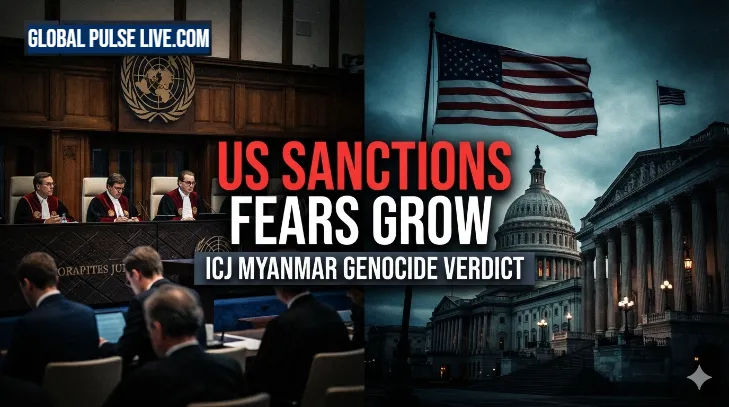
Tensions are mounting ahead of the International Court of Justice’s (ICJ) highly anticipated ruling on whether Myanmar committed genocide against the Rohingya minority, with growing concerns that the United States could impose sanctions on ICJ judges if the court delivers such a verdict.
The ruling, expected on Thursday, could become a landmark moment in international law. The ICJ has never before held a country legally responsible for genocide, making the decision one of the most significant in the court’s history. At the heart of the case is whether Myanmar’s military acted with the specific intent required under the Genocide Convention to destroy, in whole or in part, the Rohingya ethnic group.
Lawyers representing Rohingya survivors argue that military operations in Myanmar’s Rakhine State during 2016 and 2017—including mass killings, forced displacement, and attacks on civilians—demonstrate a clear pattern aimed at eliminating the community. Myanmar, however, continues to deny the allegations, maintaining that its operations targeted insurgents rather than civilians.
Concerns have intensified after reports emerged that ICJ judges have sought legal advice on protecting their assets in case Washington imposes sanctions. The possibility stems from fears within the US administration that a genocide ruling could lower the legal threshold for proving genocide in future international cases.
According to analysts, both the United States and Israel are concerned that such a judgment could establish a legal precedent that may influence future cases, including allegations related to the conflict in Gaza.
The issue has drawn additional attention because South African jurist Navi Pillay, who was awarded the 2026 Nobel Peace Prize, is serving as the ad hoc judge appointed by The Gambia in the case. Although ad hoc judges are expected to remain impartial, senior US officials have publicly questioned Pillay’s role.
US Ambassador to the United Nations Mike Waltz recently warned that Washington would closely monitor the court’s proceedings, accusing the ICJ of potentially creating legal standards that could later be used against American and allied military personnel. US Secretary of State Marco Rubio has also criticized international judicial institutions, arguing that international law should not be used as a political tool against sovereign nations.
The ICJ, based in The Hague, is the United Nations’ principal judicial body responsible for resolving disputes between states. It differs from the International Criminal Court (ICC), which prosecutes individuals accused of war crimes, crimes against humanity, and genocide.
The United States has already imposed sanctions on ICC officials following the court’s actions against Israeli Prime Minister Benjamin Netanyahu. Observers say similar measures against ICJ judges would represent an unprecedented escalation in Washington’s relationship with international judicial institutions.
Meanwhile, several European countries, including the United Kingdom, have argued before the ICJ that genocide should be assessed by examining the full range of evidence, including mass displacement, violence against women and children, and broader patterns of persecution—not only killings.
The ICJ’s verdict is expected to have far-reaching implications for international law, accountability for mass atrocities, and the future interpretation of the Genocide Convention. It could also reshape global debates over the independence of international courts and the balance between international justice and national interests.