New Delhi: The Quad Foreign Ministers’ Meeting scheduled to be hosted by India on May 26 is set against a backdrop of escalating geopolitical tensions spanning the South China Sea, Taiwan Strait, Indian Ocean, and West Asia, underscoring the increasing complexity of Indo-Pacific security dynamics.
The high-level gathering in New Delhi is widely expected to reaffirm the Quad’s position as a key pillar of the evolving Indo-Pacific strategic architecture, bringing together India, the United States, Japan, and Australia at a time of heightened global uncertainty.
Diplomatic momentum ahead of the meeting was reinforced by recent talks between US Secretary of State Marco Rubio and Prime Minister Narendra Modi in New Delhi. According to the Prime Minister’s Office, discussions covered a broad spectrum of bilateral cooperation, including defence, trade, energy security, connectivity, and strategic technologies.
The PMO also stated that Rubio shared Washington’s perspective on key regional and global developments, including the situation in West Asia, while Prime Minister Modi reiterated India’s consistent support for dialogue and diplomacy in resolving conflicts.
In a notable diplomatic development, Rubio extended an invitation to Modi for a future visit to the White House, signalling continued engagement at the highest political levels between New Delhi and Washington.
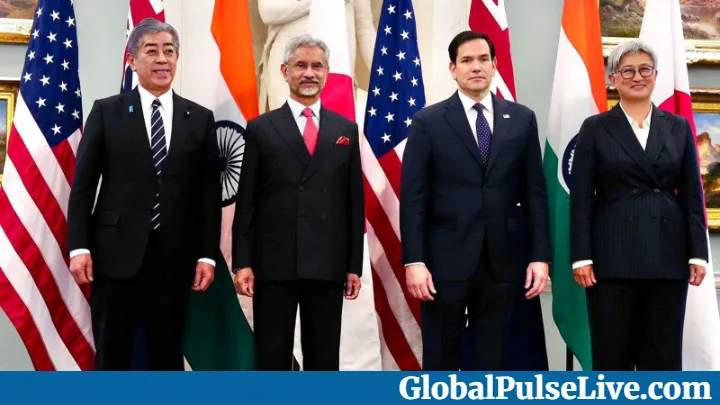
The Ministry of External Affairs said the upcoming Quad meeting will build on previous discussions held in Washington and will focus on advancing cooperation in areas such as critical technologies, supply chain resilience, maritime security, and climate-related challenges.
Australian Foreign Minister Penny Wong and Japanese Foreign Minister Toshimitsu Motegi are expected to join India’s External Affairs Minister S. Jaishankar for the ministerial dialogue.
Originally formed in the aftermath of the 2004 Indian Ocean tsunami as a humanitarian coordination mechanism, the Quad has gradually evolved into a broader strategic platform. It gained renewed momentum in 2017 amid rising concerns over China’s growing assertiveness in the Indo-Pacific and the emergence of the “Free and Open Indo-Pacific” framework.
Since its revival, the grouping has expanded its focus beyond security to include cooperation in semiconductors, critical minerals, vaccine distribution, undersea cables, and emerging technologies such as artificial intelligence and quantum computing.
India’s role as host of the latest ministerial meeting highlights its growing centrality in Indo-Pacific geopolitics and its strategy of balancing strategic autonomy with deeper engagement in minilateral groupings that do not entail formal military alliances.
Analysts, however, remain divided on the Quad’s current strategic momentum. Some experts argue that shifting US priorities and evolving geopolitical calculations may dilute the grouping’s focus, particularly amid Washington’s complex engagements in West Asia and its broader approach toward China.
Others believe the Quad continues to serve as an important platform for regional cooperation, especially as tensions persist over Taiwan, maritime security, and global supply chain stability.
Despite differing assessments, the upcoming meeting is expected to reinforce the Quad’s institutional framework and underline its role as a provider of regional public goods rather than a traditional military alliance.
As global geopolitical fault lines deepen, the New Delhi ministerial is being closely watched as a test of whether the Quad can maintain cohesion and strategic relevance in an increasingly contested Indo-Pacific order.