
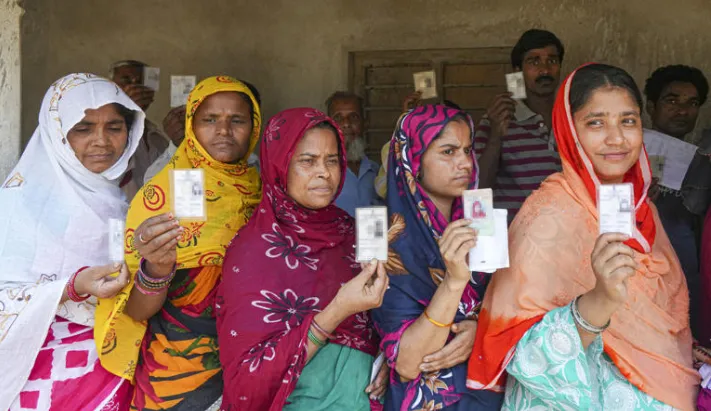
For nearly three decades, voting was a routine part of life for Shabina Yasmin. Every election season, she would walk to the polling booth in Kolkata’s Entally assembly constituency, stand in line with neighbours, and cast her vote. This year, for the first time, she stayed home.
Her name was missing from the voter list.
At first, Shabina believed it was a simple mistake. She gathered her documents, filed an appeal, and waited for the electoral tribunal to restore her name before polling day. But the hearing never came in time.
“I have voted in every election since I was married,” Shabina said. “This is the first time I could not vote. What changed? I am still the same person.”
Shabina was among 12,86,148 people in West Bengal who were unable to vote after their names were placed under “adjudication” during the state’s Special Intensive Revision (SIR) of electoral rolls.
The revision exercise was introduced as an effort to clean up voter lists by removing duplicate or ineligible names and improving the integrity of the electoral process. But critics argue that, in practice, the system ended up excluding thousands of legitimate voters who could not complete verification procedures within a limited timeframe.
For many voters, the problem began with discrepancies that are common in Indian documentation systems — minor spelling variations, mismatched records, or missing paperwork from years earlier. Once a voter’s name was flagged, the responsibility shifted entirely onto the individual to prove eligibility.
“They asked for documents from decades ago,” said Wasim Aslam, a daily wage labourer from a district outside Kolkata. “I struggle to keep recent papers safely. How can I produce records from 30 years ago?”
To address such cases, fast-track electoral tribunals were established to hear appeals and restore genuine voters before polling day. On paper, the tribunals were meant to function as a safeguard against wrongful exclusions. In reality, they struggled under the scale of the workload.
Out of 12,87,622 voters placed under adjudication, only 1,486 cases were cleared before polling.
The figures have raised concerns among legal experts and election observers. Lawyers appearing before the tribunals point out that more than 99.5 per cent of the cases that were actually reviewed resulted in voters being reinstated.
“That tells you something important,” said advocate Raghunath Chakraborty, who represented several applicants. “If almost everyone whose case is heard turns out to be eligible, then the issue lies in how the initial exclusions were carried out.”
For the overwhelming majority, however, the tribunal process never moved fast enough. Their appeals remained pending, effectively denying them the right to vote despite no final determination against them.
“The court said that if your appeal is decided before the deadline, you can vote,” Chakraborty explained. “But what happens when the system does not hear your case at all? Then your right disappears because of delay, not because of ineligibility.”
The impact was felt unevenly across the state. Of the 1,486 voters restored before polling, 1,388 were from urban constituencies, while only 42 came from largely rural areas.
Election observers say the disparity reflects broader inequalities in access. Urban voters are more likely to have transport, legal assistance, internet access, and the flexibility to repeatedly visit tribunal offices. Rural voters, particularly daily wage earners, often cannot afford to lose income while navigating lengthy procedures.
“You lose an entire day’s wage just to stand in line,” said Mohd Raja, another affected voter. “Then they ask you to come again next week. How many times can poor people keep doing that?”
The process has also raised concerns over public expenditure. Running the tribunals required judicial or quasi-judicial officers, clerical staff, data operators, office infrastructure, security arrangements, and administrative logistics across multiple districts. The cumulative cost is estimated to have reached several crores of rupees.
Former Chief Election Commissioner S. Y. Quraishi questioned both the efficiency and design of the system.
“Public money is being spent in significant amounts,” Quraishi said. “But if tribunals cost several lakh rupees to operate and only a small fraction of applicants receive relief, the cost per corrected entry becomes extremely high.”
According to him, the larger problem lies in the initial verification process itself.
“If the electoral revision is conducted carefully and transparently from the beginning, you do not need such a large and expensive corrective mechanism later,” he said. “Right now, the state is spending heavily to fix problems that could have been prevented much earlier.”
Beyond statistics and administrative debates, many affected voters describe the experience in deeply personal terms.
“They told me I can vote next time if my documents are cleared,” Shabina said quietly. “But what about this election? This was my right too.”
Her son, who had always accompanied her to vote, said this was the first election in which they were separated by a process they did not fully understand.
For more than 12 lakh people across West Bengal, participation in this democratic exercise was lost not through a final ruling, but through delays, documentation hurdles, and an overburdened system.
The controversy surrounding the SIR process has now triggered larger questions about electoral access, administrative accountability, and whether mechanisms designed to strengthen democracy can unintentionally end up restricting participation instead.