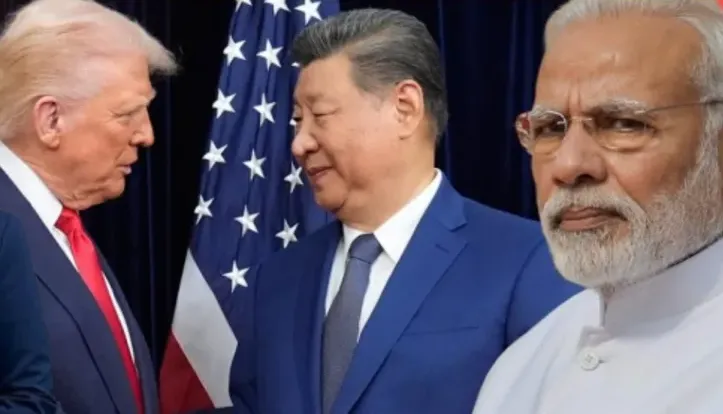
New Delhi is bracing for a defining geopolitical moment as US President Donald Trump prepares to visit China from May 13 to 15 for summit-level talks with Chinese President Xi Jinping — the first such visit by an American President to Beijing in nine years.
For India, the upcoming summit carries a mix of anxiety, opportunity, and strategic uncertainty. At stake is not just the future trajectory of US-China relations, but also India’s own geopolitical and economic positioning in an increasingly fractured global order.
The meeting comes at a time of heightened global turbulence marked by trade wars, supply chain disruptions, energy insecurity, and ongoing tensions surrounding Taiwan and Iran. As the world’s two largest economies and India’s biggest trading partners, any shift in relations between Washington and Beijing has immediate implications for New Delhi.
India’s concerns are compounded by Trump’s reputation for abrupt policy reversals. During his first term, Trump strongly backed the QUAD grouping — comprising the US, India, Japan, and Australia — as a strategic counterweight to China. However, in his second term, Washington appeared to soften its emphasis on the bloc, leaving regional partners uncertain about America’s long-term strategic commitments.
For New Delhi, the most favourable outcome from the Beijing summit would be a carefully managed balance between the two powers rather than a dramatic strategic realignment. If the US and China choose to “tolerate” and economically engage each other while continuing to compete selectively, India could continue pursuing its long-standing policy of “strategic autonomy.”
Such a scenario would allow India to deepen defence cooperation with the United States while simultaneously expanding engagement with China-led multilateral platforms such as BRICS and the Shanghai Cooperation Organisation (SCO). India would also benefit from maintaining relevance within both Western and emerging geopolitical groupings.
Recent diplomatic developments suggest some room for optimism. China has backed India’s chairmanship of BRICS this year, while India has extended support for China’s leadership of the grouping in 2027 — a sign that both countries are attempting to stabilise ties despite lingering border tensions.
However, Indian policymakers remain wary of a worst-case scenario: the emergence of a new “G-2” understanding between Washington and Beijing. A deeper strategic partnership between the world’s two biggest powers could diminish India’s importance in global decision-making and weaken its leverage with both sides.
Trade remains another major area of concern. India, despite being viewed as a close US partner, currently faces some of the highest US tariffs among major economies — at 50 per cent — compared to 47 per cent for China, Washington’s principal strategic rival. Any easing of tariffs or trade restrictions on China could reduce investor interest in relocating manufacturing and supply chains to India.
Energy security is also emerging as a sensitive issue. If Beijing secures favourable exemptions or arrangements from Washington in sectors such as energy and critical minerals, India could find itself at a disadvantage in securing stable and affordable supplies.
There is also concern over proposals for institutional mechanisms, including a possible “Board of Trade” to manage US-China economic relations. Indian strategists fear such frameworks could bypass emerging economies like India and consolidate decision-making between the two superpowers.
Still, New Delhi sees an opening amid the uncertainty. Trump has indicated that a trade agreement with India could be finalised soon, offering India an opportunity to strengthen economic ties with Washington even as global alignments evolve.
To reduce the risks arising from a possible US-China rapprochement, analysts believe India must also deepen engagement with other strategic and economic partners, particularly the European Union and ASEAN nations.
As Trump and Xi prepare to meet in Beijing, India finds itself watching closely from the sidelines — aware that the outcome could reshape not only global geopolitics, but also its own place in the emerging world order.