
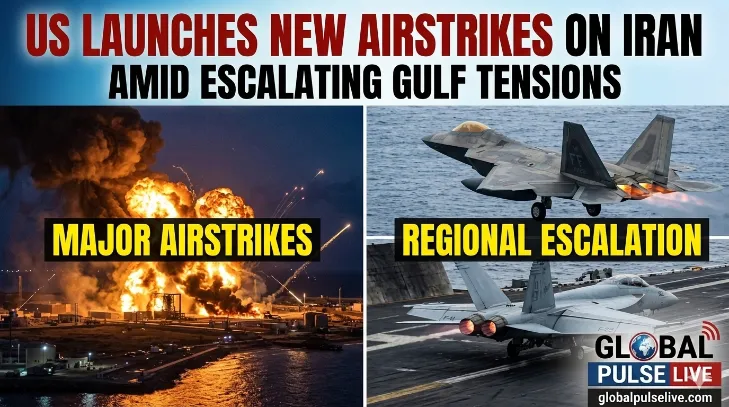
Washington/Tehran: The United States launched a new wave of airstrikes against Iran on Thursday, dramatically escalating tensions in the Middle East just hours after President Donald Trump warned of stronger military action unless Tehran halted attacks on commercial shipping in the strategically vital Strait of Hormuz.
The latest exchange marks the most significant military confrontation between the two countries since they signed a memorandum of understanding (MoU) on June 17, aimed at extending a ceasefire and creating space for negotiations toward a permanent peace agreement.
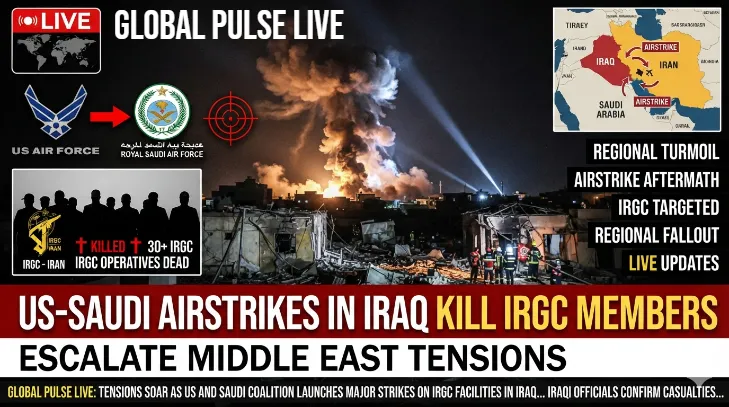
According to the US military, approximately 90 targets across Iran were struck, including missile launchers, military installations and a runway. Washington said the operation was intended to weaken Iran’s ability to threaten international shipping through the Strait of Hormuz, a critical maritime route that carries nearly 20 percent of the world’s oil and gas supplies.
President Trump defended the strikes, describing them as retaliation for Iran’s alleged attacks on ships in the Strait of Hormuz.
“This is in retribution for yesterday’s bombing of ships by Iran. If it happens again, it will get much worse,” Trump said in a post on Truth Social, warning Tehran against further military action.
Iran strongly condemned the strikes, accusing the US of targeting areas near its only civilian nuclear power plant in Bushehr Province and striking critical infrastructure, including bridges leading to the holy city of Mashhad. Iranian officials alleged the attacks endangered civilian facilities and described them as violations of international law.
Bushehr Deputy Governor Ehsan Jahanian said several locations, including the perimeter of the Bushehr nuclear power plant, a military base in Choghadak and a fishing port, were targeted. No casualties were immediately reported at the nuclear facility, though separate strikes elsewhere reportedly killed several civilians and military personnel.
In retaliation, Iran launched missile attacks targeting military facilities used by US allies in the Gulf region. Iran’s Islamic Revolutionary Guard Corps claimed responsibility for firing ballistic missiles toward Jordan’s Azraq military base, which is used by the US Air Force. Sirens also sounded multiple times in Bahrain, home to the US Navy’s Fifth Fleet. No immediate reports of major damage or casualties emerged from Jordan or Bahrain.
The renewed conflict unfolded as Iran held funeral ceremonies for former Supreme Leader Ayatollah Ali Khamenei in Mashhad. Millions reportedly participated in memorial processions across Iran, Iraq and Lebanon, with many mourners calling for retaliation against the United States. Observers closely watched whether Iran’s new Supreme Leader, Mojtaba Khamenei, would appear publicly following reports that he had been injured in earlier attacks.
The military escalation has intensified fears that the fragile ceasefire agreement between Washington and Tehran could collapse completely. Negotiations had been expected to resume after the conclusion of the funeral ceremonies, but the latest violence has cast serious doubt over prospects for a diplomatic breakthrough.
The Strait of Hormuz remains at the center of the dispute. Iran has insisted on regulating and charging transit fees for vessels passing through the waterway, while the United States maintains that it is an international shipping lane that must remain open to global commerce.
The recent hostilities briefly pushed global oil prices higher amid concerns over energy supplies before markets stabilized later in the day.
Iranian officials warned that any further US military action would provoke a “crushing response,” while senior Iranian Parliament Speaker Mohammad Bagher Ghalibaf declared that continued American pressure would only invite stronger retaliation.
Meanwhile, regional mediators, including Qatar, have renewed diplomatic efforts to prevent a wider conflict. Qatar’s Prime Minister Sheikh Mohammed bin Abdulrahman Al Thani held talks with Iranian Foreign Minister Abbas Araghchi in an attempt to reduce tensions and preserve the possibility of future negotiations.
With both sides exchanging threats and military strikes, international observers fear the latest escalation could further destabilize the Middle East and disrupt global energy markets if diplomatic efforts fail.