
Norway’s decision to become a partner in India’s Indo-Pacific Oceans Initiative (IPOI) during Prime Minister Narendra Modi’s visit to Oslo marks a significant expansion of international cooperation in the strategically vital Indo-Pacific region. The move underlines a growing recognition among global powers that maritime stability in the Indo-Pacific is no longer solely a regional concern, but a matter closely tied to global trade, environmental sustainability, and the future of the rules-based international order.
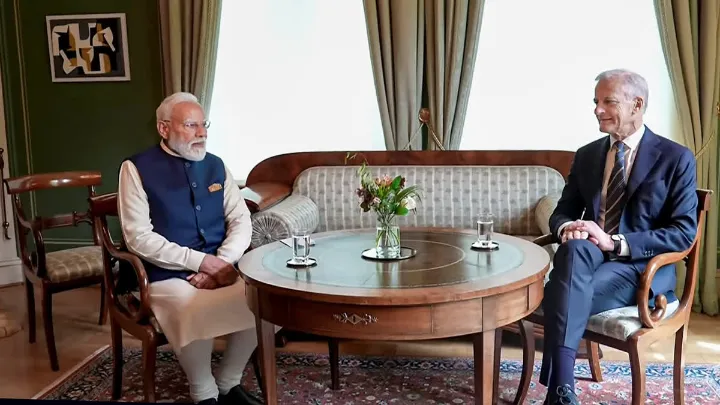
The development came during bilateral talks between Prime Minister Modi and Norwegian Prime Minister Jonas Gahr Støre, where both sides reaffirmed their commitment to deeper cooperation in the blue economy and maritime governance.
In a joint statement issued after the summit, the two leaders agreed to “continue and strengthen the excellent cooperation in the domain of Blue Economy” under the Memorandum of Understanding on Ocean Dialogue signed in 2019. They also reiterated their shared commitment to international maritime law, particularly the United Nations Convention on the Law of the Sea (UNCLOS), and stressed the importance of freedom of navigation and overflight in international waters.
The statement further noted that India welcomed Norway’s decision to join the Indo-Pacific Oceans Initiative.
Launched by India in 2019 at the ASEAN-led East Asia Summit, the IPOI is a voluntary and non-treaty framework aimed at promoting cooperation among like-minded countries committed to a free, open, inclusive, and rules-based maritime order in the Indo-Pacific.
The initiative is structured around seven key pillars: maritime security; maritime ecology and environment; marine resources; capacity building and resource sharing; disaster risk reduction and management; science, technology and academic cooperation; and trade, connectivity and maritime transport.
Countries already contributing to different pillars include Australia in maritime ecology, France and India in marine resources, and Japan in connectivity and infrastructure. Singapore and the United Kingdom have also participated in scientific and academic cooperation, while Indonesia has expressed interest in maritime security collaboration.
Norway’s inclusion is being viewed as a major strategic and diplomatic gain for the initiative. Widely regarded as one of the world’s leading maritime nations, Norway possesses extensive expertise in shipping, marine science, sustainable fisheries, and ocean governance.
Its participation significantly broadens the geographical reach of the IPOI, connecting Europe’s advanced maritime systems and policy frameworks with partners across the Indian and Pacific Oceans. Analysts say this reflects increasing global awareness that the Indo-Pacific is central to the future of economic connectivity and geopolitical stability.
The region today accounts for more than 60 per cent of global maritime trade, making the security of its sea lanes essential for the global economy. Ongoing tensions in areas such as the South China Sea and the Red Sea have heightened concerns over maritime security and uninterrupted commercial navigation.
Norway’s entry into the IPOI also strengthens support for an international maritime order based on established legal norms. As a long-standing advocate of international law and peaceful dispute resolution, Norway’s involvement adds diplomatic weight to principles such as freedom of navigation, maritime security cooperation, and adherence to UNCLOS.
Environmental sustainability is another area where Norway is expected to play a crucial role. The Nordic nation is internationally recognised for its leadership in marine ecology, ocean science, and sustainable management of marine resources. Experts believe Norwegian expertise can significantly contribute to the IPOI’s work on marine conservation, disaster resilience, scientific collaboration, and climate-related maritime challenges.
The partnership is also expected to deepen India-Norway cooperation on practical maritime issues including anti-piracy operations, humanitarian assistance, emergency response mechanisms, and coastal resilience initiatives. In addition, both countries are likely to collaborate on capacity building for smaller coastal and island nations across the Indo-Pacific region through technical cooperation, training, and knowledge sharing.
Strategic analysts see Norway’s move as part of a broader trend of increasing European engagement in the Indo-Pacific amid evolving geopolitical realities.
“The Indo-Pacific has become the centre of geopolitical and economic rivalry in the 21st century,” said K Yhome, Fellow at the Shillong-based Asian Confluence think tank and an expert on Indo-Pacific affairs.
According to Yhome, European nations are increasingly looking toward the Indo-Pacific as global strategic dynamics shift, particularly amid uncertainties in trans-Atlantic relations under US President Donald Trump’s administration.
“In that context, European countries are also looking at alternative partners so that they can become part of this rapidly rising Indo-Pacific region,” he said.
Yhome added that Norway’s decision reflects wider international efforts to ensure the Indo-Pacific is not dominated solely by major power competition between the United States and China.
“There is this big contest emerging between the US and China, and countries in Europe and Latin America are looking for alternatives so that the Indo-Pacific is not shaped by just two powers,” he observed.
Norway’s participation in the IPOI is therefore being seen as more than a symbolic diplomatic gesture. It signals growing international support for cooperative, multilateral approaches to maritime governance and regional stability.
By bringing together expertise in maritime security, sustainable ocean management, scientific innovation, and disaster resilience, the partnership between India and Norway is expected to strengthen the IPOI’s long-term objective of building an open, secure, and inclusive Indo-Pacific framework.
As geopolitical competition intensifies across critical sea lanes and maritime regions, Norway’s entry into the initiative highlights the increasing globalisation of Indo-Pacific affairs — and the recognition that the future of international commerce and maritime cooperation will be shaped decisively in these waters.