
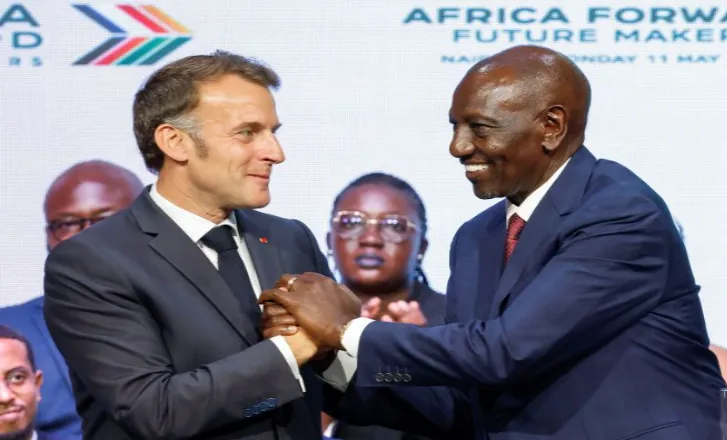
Nairobi — France has convened its long-running French-African summit in a non-francophone country for the first time, as President Emmanuel Macron attempts to redefine Paris’s relationship with Africa after a series of political and military setbacks in its former colonies.
The summit, branded “Africa Forward,” is being held in Kenya’s capital Nairobi and has brought together more than 30 heads of state and government, along with representatives from the African Union, financial institutions and development organisations.
Analysts say the move signals a strategic shift by France to expand its diplomatic reach beyond traditional francophone allies and rebuild influence on a continent where its presence has significantly weakened in recent years.
Macron calls for “sovereign equality” and investment-led partnerships
Addressing delegates on Tuesday, Macron announced new investment commitments and said France’s future engagement with Africa would be based on partnership rather than aid.
“Sovereignty and autonomy is shared, and your success is our success,” Macron said. He added that “the days of offering assistance are behind us,” signalling a shift toward what he described as “co-investment” and mutually beneficial economic engagement.
Macron emphasised that future cooperation should be built on “sovereign equality, not on aid or charity but on mutually beneficial investment, and not on extraction or exploitation but on win-win engagements.”
The French president also said the summit represented a break from past models of engagement that were often criticised as paternalistic or unequal.
A shift away from France’s historic “Françafrique” influence
For decades, France maintained close political, military and economic ties with its former colonies under an informal system widely referred to as “Françafrique.” However, that influence has sharply declined in recent years amid growing anti-French sentiment in parts of West and Central Africa.
Several countries in the region have experienced military coups accompanied by public backlash against France, with accusations of neocolonial interference. Since 2022, French troops have been withdrawn from Mali, Niger and Chad, and multiple governments have ended defence agreements with Paris.
The deterioration of relations has forced France to reconsider its approach, particularly in francophone West Africa, where its traditional influence has been most severely challenged.
Kenya hosts summit as France seeks new diplomatic ground
Holding the summit in Kenya — an anglophone country with no colonial French legacy — is being interpreted as a deliberate attempt by Paris to reposition itself.
International relations analyst Mikhail Nyamweya said the location reflects France’s effort to move beyond its traditional sphere of influence.
“France is trying to repackage its Africa policy through an anglophone diplomatic hub, and to present the relationship as broader, more economic, and less tied to its colonial past,” he said.
Kenya’s government has sought to position the country as a regional diplomatic hub under President William Ruto, who has promoted Kenya’s role in international security and climate diplomacy, including leadership of a security mission in Haiti and hosting a major Africa climate summit.
Strategic convergence between Paris and Nairobi
Professor Macharia Munene, a scholar of international relations, said the summit also reflects overlapping strategic interests between Macron and Ruto.
“There was a convergence of interests,” he said, noting Macron’s efforts to strengthen France’s global leadership role and Kenya’s ambition to act as a convening power for international dialogue.
France and Kenya signed a defence agreement last year, though it has faced criticism from opposition groups and civil society organisations in Kenya, who argue it raises sovereignty concerns. In March, 800 French troops arrived in Kenya for joint training and security exercises.
Tensions linger despite diplomatic reset efforts
Despite Macron’s emphasis on renewed partnerships, France’s absence from several key West African states remains notable. Leaders from Mali, Burkina Faso and Niger were not present at the summit, reflecting ongoing political rifts between Paris and military governments in those countries.
At a joint press conference with President Ruto in Nairobi on Sunday, Macron acknowledged the strained relations but said France remained engaged with African societies even where government ties had broken down.
“We can disagree with some of these governments, but we never disagree with people. We love these people,” he said.
A test of France’s future role in Africa
The Nairobi summit is widely seen as a test of whether France can successfully transition from a historically dominant post-colonial power to a partner operating on more equal economic and political terms.
Whether the “Africa Forward” initiative translates into lasting influence or merely reflects France’s reduced standing on the continent remains an open question as geopolitical competition in Africa continues to intensify.