
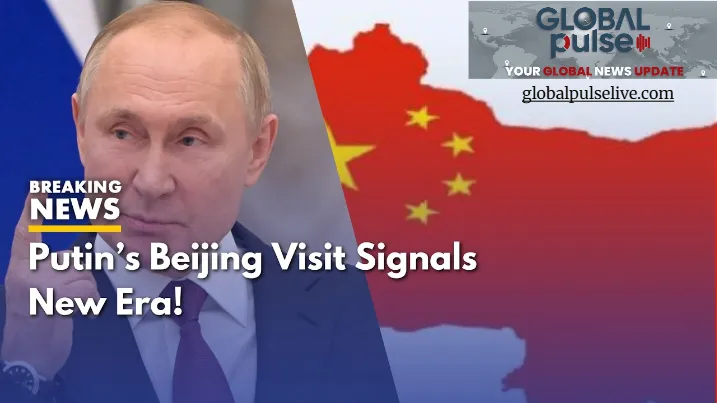
China: Russian President Vladimir Putin arrived in Beijing on Tuesday for a high-profile state visit, just days after former U.S. President Donald Trump concluded his own trip to China — a diplomatic sequence widely viewed as a sign of Beijing’s rising global influence.
The visit marks Putin’s 25th trip to China and further highlights the increasingly close relationship between the Russian leader and Chinese President Xi Jinping. The two leaders have now met more than 40 times, making Putin the foreign leader Xi has engaged with most frequently during his time in power.
Analysts say the timing of the visit is significant, particularly as China seeks to position itself as a central player in global diplomacy amid intensifying tensions with the West.
William Yang, a senior analyst at the International Crisis Group, said hosting both Trump and Putin within the span of a week demonstrates Beijing’s growing confidence on the world stage.
“Xi likely wants to remind Washington that China has strong partnerships it can rely on,” Yang said. “The message is that efforts to isolate Beijing would not succeed easily.”
Putin’s visit comes at a difficult moment for Russia. More than two years into the war in Ukraine, Moscow has struggled to secure major battlefield gains, while Western sanctions continue to weigh heavily on the Russian economy. As economic pressures mount, Russia has become increasingly dependent on China for trade, energy exports, and diplomatic support.
In a video address released ahead of the visit, Putin described China-Russia ties as being at “an unprecedented level.” He pointed to booming bilateral trade, the growing use of the yuan and rouble instead of the U.S. dollar in financial transactions, and expanded visa-free travel between the two countries.
Chinese Foreign Ministry spokesperson Guo Jiakun said the partnership between Beijing and Moscow would continue to deepen under the “strategic guidance” of Xi and Putin.
This year marks 30 years since China and Russia established a formal strategic partnership and 25 years since signing the Treaty of Good-Neighbourliness and Friendly Cooperation.
The strengthening economic relationship between the two nations has become increasingly important since the start of Russia’s full-scale invasion of Ukraine. China has continued purchasing Russian oil and gas despite Western sanctions, helping Moscow offset the loss of European markets.
One major project expected to dominate discussions is the proposed Power of Siberia 2 pipeline, a massive natural gas route stretching through Mongolia into China. The project would significantly increase Russian gas exports to China and further deepen energy cooperation between the two countries.
For Russia, the pipeline is viewed as essential to replacing energy revenues lost after Europe sharply reduced imports following the Ukraine war. For China, increased overland energy supplies from Russia could reduce dependence on vulnerable maritime routes such as the Strait of Hormuz.
However, some analysts warn that deeper energy ties could also increase China’s dependence on Russia at a time when Beijing is prioritizing long-term energy self-sufficiency.
Putin’s relationship with Xi has also become a factor in China’s increasingly complex ties with the United States. During Trump’s recent visit to Beijing, Xi reportedly gave the former U.S. president a rare private tour of Zhongnanhai, the Chinese leadership compound often referred to as “China’s Kremlin.” Xi noted that Putin was among the few foreign leaders previously invited there.
Meanwhile, Western governments continue to criticize China for maintaining strong economic links with Moscow and for exporting dual-use technologies that could support Russia’s military operations.
China itself has faced growing sanctions pressure. Earlier this month, Beijing protested after the United Kingdom added two Chinese entities to its Russia sanctions list.
Although Ukraine was not publicly discussed in detail during Trump and Xi’s recent talks, reports later suggested Xi may have privately indicated that Putin could eventually regret launching the war — a claim denied by China’s Foreign Ministry.
Still, signs of strain inside Russia are becoming more visible. The war in Ukraine has settled into a grinding stalemate, while Ukrainian drone and missile strikes have increasingly targeted Russian energy infrastructure and military facilities.
On Tuesday, a Russian regional lawmaker publicly called for a “swift conclusion” to the war, warning that Russia’s economy might not survive a prolonged conflict — a rare acknowledgment of the mounting domestic pressures facing the Kremlin.