
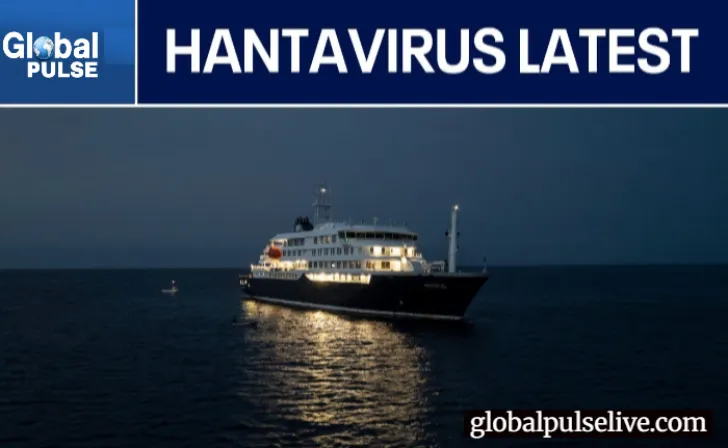
Madrid — The World Health Organization has urged countries to prepare for possible additional hantavirus cases following an outbreak aboard the cruise ship MV Hondius, while praising Spain for what it called a “model response” in managing the emergency evacuation of passengers and crew.
WHO Director-General Tedros Adhanom Ghebreyesus said authorities should follow established guidelines, including quarantine measures of up to 42 days and close monitoring of high-risk contacts, given the virus’s long incubation period.
“At the moment, there is no sign that we are seeing the start of a larger outbreak, but the situation could change,” Tedros said at a press conference in Madrid on Tuesday. “Given the long incubation period of the virus, it’s possible we might see more cases in the coming weeks.”
Deaths and confirmed cases aboard MV Hondius
The outbreak came to international attention after three passengers — a Dutch couple and a German national — died from hantavirus infection while travelling aboard the MV Hondius, which had been sailing from Argentina to Cape Verde.
Although hantavirus is primarily transmitted through contact with infected rodents, limited human-to-human transmission has been documented in rare cases involving close contact.
The World Health Organization has confirmed at least nine cases of the Andes variant of the virus among passengers evacuated from the ship, including individuals from France and the United States.
On Tuesday, Spain’s Health Ministry confirmed that one of the 14 Spanish nationals evacuated and placed under quarantine at a military hospital in Madrid had tested positive for hantavirus. Officials said the patient was in stable condition, experiencing only mild symptoms including low-grade fever.
WHO warns more cases likely due to onboard exposure
Tedros said further infections were expected due to extensive interaction among passengers before containment measures were introduced onboard.
“There was a lot of interaction between passengers before the first confirmed case,” he said, noting that the virus’s incubation period can extend up to eight weeks.
“We would expect more cases because of what happened during the travel.”
He added that responsibility for monitoring and care now rests with individual countries following evacuation.
“I hope they will take care of the patients and the passengers, helping them and also protecting their citizens as well,” he said.
Spain praised for evacuation and coordination
More than 120 passengers and crew were evacuated from the MV Hondius in a coordinated operation off the Canary Islands, after Cape Verde authorities refused the ship permission to dock.
The vessel was later allowed to anchor and briefly dock in Tenerife under Spanish central government approval, despite objections from regional authorities.
Tedros praised Spain’s handling of the situation, describing it as an example of international cooperation.
“I’d like to thank Spain and especially Prime Minister Pedro Sánchez for outstanding leadership and coordination,” he said. “This is a model — not just in obligation, but in compassion and solidarity.”
Spanish Prime Minister Pedro Sánchez echoed the sentiment, calling for greater global cooperation in times of crisis.
“This world doesn’t need more selfishness, nor more fear,” Sánchez said. “It needs countries that show solidarity and want to move forward.”
He also expressed condolences to the family of a Guardia Civil officer who died of a heart attack during the evacuation operation.
Ongoing monitoring and international response
The final evacuees departed the Canary Islands on Monday and arrived in the Netherlands early Tuesday. The MV Hondius has since left Tenerife after refuelling and is now en route to Rotterdam with a reduced crew and medical personnel onboard.
The WHO said it will continue to monitor the situation closely as countries conduct follow-up testing and quarantine measures for those exposed.
Health experts say the case highlights the challenges of managing infectious disease outbreaks in confined environments such as cruise ships, where rapid transmission can occur before symptoms are detected.