
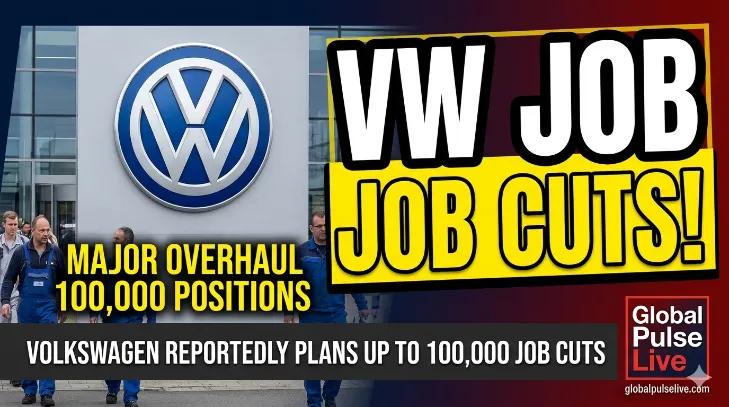
Berlin: German automotive giant Volkswagen is reportedly preparing one of the biggest restructuring programmes in its history, with plans to cut up to 100,000 jobs and gradually halt production at several manufacturing plants as it battles rising competition and mounting financial pressures.
According to German media reports, the proposals were presented during a recent management meeting and are expected to be discussed at a supervisory board meeting next month. If approved, the move would more than double the workforce reductions the company announced in 2024.
Volkswagen has declined to comment directly on the reported figures, saying it would not “pre-empt the process” while discussions with employee representatives and labour unions continue.
The Volkswagen Group employs more than 650,000 people worldwide across its portfolio of brands, including Audi, Bentley, Skoda, Seat and Cupra. The company has come under increasing pressure from fast-growing Chinese automakers, particularly in the electric vehicle (EV) market, while also facing slowing demand and the costly transition away from traditional combustion-engine vehicles.
A company spokesperson acknowledged that the automotive industry is undergoing a “profound transformation” and admitted that Volkswagen’s traditional business model—designing vehicles in Germany, manufacturing them across Europe and exporting them globally—is no longer sufficient in today’s rapidly changing market.
“The world has fundamentally changed in recent years,” the spokesperson said, pointing to fierce global competition, trade tariffs and weakening demand in several key markets.
Volkswagen Chief Executive Oliver Blume has already unveiled a strategy aimed at reducing operating costs by €11 billion. The latest proposals reportedly include the possible closure of four German production facilities over the medium term, including an Audi plant in Neckarsulm and Volkswagen factories in Hanover, Zwickau and Emden. However, the plans could still be modified following negotiations with labour representatives.
The company said adapting to the evolving automotive landscape requires stricter control over spending and greater efficiency across all its brands and subsidiaries.
Despite the challenges, Volkswagen has recently shown signs of recovery in China, the world’s largest automobile market. During the first two months of 2026, the company regained the top position in passenger vehicle sales, overtaking domestic electric vehicle leader BYD as government subsidies for EVs began to ease. Toyota also improved its market position during the same period.
Nevertheless, competition remains intense. Earlier this month, BYD’s chairman announced the company’s ambition to become the world’s largest automobile manufacturer within the next five years, challenging Toyota’s long-standing global leadership.
Industry analysts believe Volkswagen’s restructuring reflects the growing pressure on traditional automakers to remain competitive in an industry increasingly dominated by electric vehicles, digital technologies and aggressive Chinese manufacturers. The outcome of the company’s restructuring talks is expected to have far-reaching implications for Europe’s automotive sector and thousands of workers across the continent.