
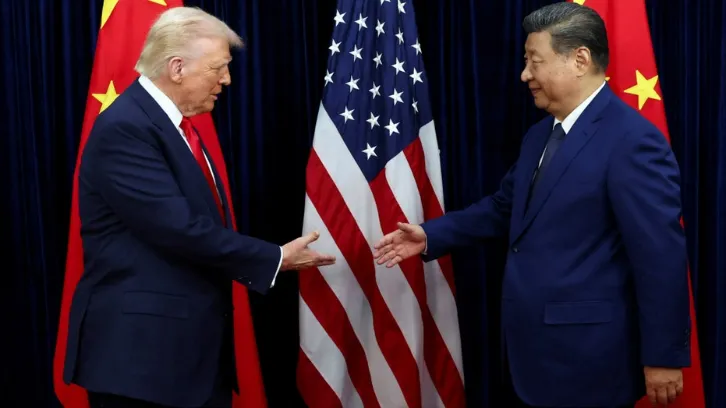
China- Beijing: U.S. President Donald Trump and Chinese President Xi Jinping concluded high-stakes talks in Beijing on Friday, presenting a united front on improving bilateral relations despite ongoing tensions over Taiwan, Iran and trade-related security concerns.
The summit ended after a final round of discussions at Zhongnanhai, the Chinese leadership compound in central Beijing, where Xi hosted Trump for private meetings, tea and lunch before the American president departed for Washington.
The two leaders walked together through the historic grounds, lined with ancient trees, traditional Chinese architecture and blooming rose gardens. Trump appeared visibly impressed by the setting, reportedly praising the roses as “the most beautiful” he had ever seen. Xi later offered to send rose seeds to the U.S. president in what observers viewed as a symbolic diplomatic gesture.
Speaking before the closed-door meeting, Trump described the summit as “a great couple of days,” emphasizing progress in stabilizing ties between the world’s two largest economies. Xi called the visit a “milestone,” saying the two countries had established “a constructive, strategic and stable relationship.”
Despite the optimistic rhetoric, major policy disagreements remained unresolved.
One of the most sensitive issues was Taiwan, the self-governed island claimed by China. According to Chinese officials, Xi warned Trump during private discussions that mishandling the Taiwan issue could push the two nations toward “clashes and even conflicts.”
The remarks underscored Beijing’s increasing insistence that Taiwan remains the “core” issue in U.S.-China relations. China has intensified diplomatic pressure in recent months amid concerns over growing U.S. support for Taipei.
U.S. Secretary of State Marco Rubio, who joined Trump during the talks, reaffirmed that Washington’s position on Taiwan had not changed. In comments to NBC News, Rubio warned that any attempt by China to seize Taiwan by force would be “a terrible mistake.”
“They always raise it on their side. We always make clear our position, and we move on to the other topics,” Rubio said.
Iran also emerged as a point of friction during the summit. While Trump suggested in a recent Fox News interview that Xi had expressed willingness to help address tensions involving Tehran, Beijing has publicly shown little enthusiasm for taking a larger role.
The issue has become increasingly sensitive as Washington accuses Chinese firms of assisting Iran through satellite imagery support and oil purchases. The U.S. Treasury Department has recently targeted Chinese refineries and shipping operators allegedly involved in importing Iranian oil.
Another unresolved concern for the White House is the continued flow of Chinese-made chemical precursors used in the production of fentanyl, a synthetic opioid linked to a deadly drug crisis across the United States. American officials argue that China must do more to prevent such materials from reaching criminal networks in Mexico.
Even so, both governments sought to frame the summit as a stabilizing moment after years of strained relations marked by trade disputes, military tensions and competing geopolitical ambitions.
The invitation to Zhongnanhai itself was viewed by analysts as an unusually personal diplomatic gesture from Xi toward Trump, who has often emphasized personal relationships with foreign leaders. Unlike the White House or the Kremlin, Zhongnanhai rarely serves as the main venue for foreign diplomatic engagements.
In a television interview following the meetings, Trump described Xi as “warm” but “all business,” adding, “There’s no games.”
While the summit produced no major breakthrough agreements, officials from both sides signaled that continued dialogue would remain essential as Washington and Beijing navigate an increasingly complex and competitive relationship.