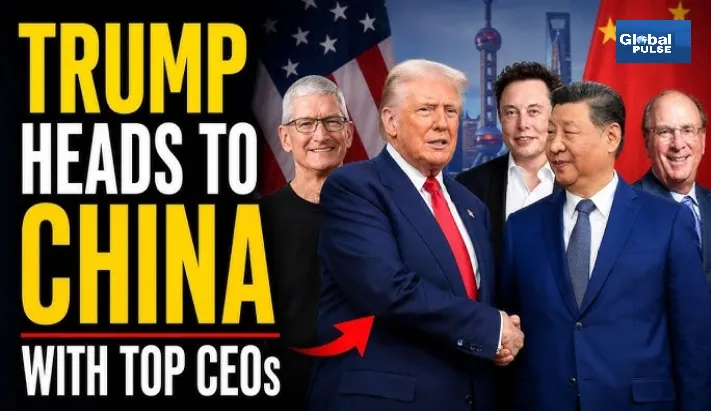
US President Donald Trump is set to travel to China this week with a high-profile delegation of technology leaders, signaling that artificial intelligence, semiconductors and digital trade are likely to feature prominently in talks with Chinese President Xi Jinping.
According to a White House official, the guest list includes outgoing Apple CEO Tim Cook, Tesla and SpaceX CEO Elon Musk, Meta president Dina Powell McCormick, Micron CEO Sanjay Mehrotra, Cisco CEO Chuck Robbins, and Qualcomm CEO Cristiano Amon.
The unusually large tech contingent suggests the visit may focus as much on economic and technological cooperation — and competition — as on traditional diplomatic issues, even as broader geopolitical tensions remain high.
However, one notable absence stands out: Nvidia CEO Jensen Huang. The chipmaker, central to the global AI boom, has been a vocal critic of US restrictions on advanced semiconductor exports to China. In an April interview, Huang warned against what he called a “loser mentality” that could weaken America’s long-term leadership in artificial intelligence.
His absence is seen by analysts as potentially limiting the scope of any major semiconductor breakthrough during the visit, though smaller agreements — particularly involving memory and networking hardware — remain possible. Micron, in particular, is viewed as a company that could announce new developments tied to the Chinese market.
Apple’s Tim Cook is expected to play a key diplomatic role. Apple continues to rely heavily on China for manufacturing while also seeing strong consumer demand there, with the iPhone 17 reportedly driving record quarterly earnings. The company has also been steadily shifting parts of its supply chain to India and Vietnam in recent years.
Cook’s inclusion in the delegation highlights his increasingly prominent geopolitical role. Apple has previously described him as central to managing relationships with world leaders as global supply chains and technology regulation become more politically sensitive.
The visit comes at a time when both Washington and Beijing are tightening oversight of artificial intelligence. China already requires AI developers to submit models for government review, with rules covering security risks and politically sensitive content.
In parallel, the Trump administration is reportedly considering new measures that would require leading US AI companies to submit frontier models for White House review. The government has already begun coordinating security evaluations with firms including Google DeepMind, Microsoft, and Elon Musk’s xAI, under oversight from the Center for AI Standards and Innovation within the Department of Commerce.
Tensions over AI governance are also playing out in the private sector. The Pentagon remains in a legal dispute with Anthropic over concerns about military applications of its technology, while US officials are also debating access restrictions around advanced cybersecurity-focused AI systems.
Vice President JD Vance has reportedly urged Anthropic to limit expansion of its model deployments to select partners, according to reporting from the Wall Street Journal, underscoring internal disagreements over how widely powerful AI systems should be distributed.
Despite friction in the US-China relationship, Trump’s past foreign trips have sometimes resulted in major commercial announcements, particularly during his 2025 Middle East visit, which yielded a series of investment and technology deals.
Whether this China visit produces similar outcomes remains uncertain. But with some of Silicon Valley’s most influential executives at the table, the trip is already being closely watched as a potential turning point in global tech diplomacy.