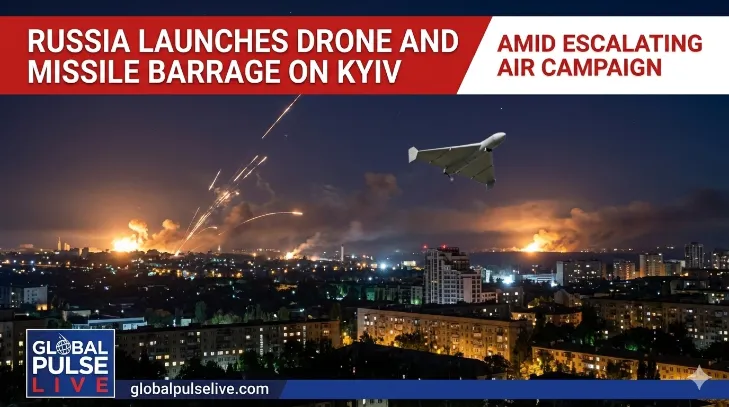


Kyiv: Russia launched one of its largest aerial assaults on Ukraine overnight, striking Kyiv and surrounding regions with drones and missiles, including the powerful hypersonic Oreshnik ballistic missile, Ukrainian officials said on Sunday. The attack killed at least four people and injured around 100 others across the country.
Ukrainian President Volodymyr Zelenskyy said Russia used the Oreshnik missile to target the city of Bila Tserkva in the Kyiv region. The strike damaged critical infrastructure, including a water supply facility, while also destroying a market, residential buildings and schools.
“They are genuinely deranged,” Zelenskyy wrote on Telegram after the attack.
In a later post on X, Zelenskyy said Kyiv had been the primary target of the assault, which involved approximately 600 drones and 90 missiles of various types, including 36 ballistic missiles.
“Unfortunately, not all of the ballistic missiles were intercepted – the largest number of hits was in Kyiv,” he said. “It is important that this does not pass without consequences for Russia.”
Russia’s defence ministry confirmed the use of the Oreshnik missile, marking the third time the weapon has reportedly been deployed during the war. Moscow said the strikes also involved Iskander, Kinzhal and Zircon missiles, targeting Ukrainian military command centres, airbases and defence-related facilities.
According to Russian officials, the attack was carried out in retaliation for Ukrainian strikes on civilian sites inside Russian territory.
The Oreshnik missile, capable of carrying either conventional or nuclear warheads, has drawn international concern because of its extreme speed and destructive capability. Russian President Vladimir Putin has previously claimed the missile travels at nearly 10 times the speed of sound and is nearly impossible to intercept.
Kyiv Mayor Vitali Klitschko said two people were killed and at least 56 injured in the capital. Authorities in the wider Kyiv region confirmed two additional deaths and several injuries.
Klitschko said every district of Kyiv suffered some level of damage. Fires broke out in schools and commercial buildings, while several civilians became trapped in shelters after nearby explosions.
Residents described scenes of devastation and panic throughout the night.
“It was a terrible night and there has never been anything like it in the entire war,” Kyiv resident Svitlana Onofryichuk told the Associated Press after the market where she had worked for more than two decades was destroyed.
“My job is gone, everything is gone, everything has burned down,” she said.
Another resident, 74-year-old Yevhen Zosin, said the shockwaves from the explosions shattered his apartment.
“Then there was another explosion and she and I were thrown back like a pin by the shock wave,” he said, referring to his dog. “My apartment was blown to pieces.”
Several cultural and government buildings were also damaged during the assault. Ukraine’s National Art Museum suffered broken windows, shattered ceilings and interior damage, according to the culture ministry. Officials said the museum’s collection appeared to have escaped major harm.
Ukraine’s foreign ministry building was damaged for the first time since World War II, Foreign Minister Andrii Sybiha said. He described the strikes on Kyiv’s historic district as evidence of “barbaric” attacks on Ukrainian heritage.
Prime Minister Yulia Svyrydenko confirmed that government headquarters also sustained damage, though no injuries were reported there.
The barrage came shortly after Putin vowed retaliation over a drone strike in Russian-controlled Luhansk, which Moscow claimed killed 21 people in a student dormitory. Ukraine denied targeting civilians and said it had struck a Russian drone command unit in the area instead.
The latest escalation drew strong condemnation from European leaders. French President Emmanuel Macron described the use of the Oreshnik missile as proof of “the dead end of Russia’s war of aggression,” while German Chancellor Friedrich Merz called it a “reckless escalation.”
EU foreign policy chief Kaja Kallas accused Russia of deliberately terrorising civilians after setbacks on the battlefield.
“These are abhorrent acts of terror meant to kill as many civilians as possible,” she said, describing the missile strike as “reckless nuclear brinkmanship.”
Austria’s Foreign Minister Beate Meinl-Reisinger and UK Home Secretary Yvette Cooper also voiced support for Ukraine and condemned the attacks.
Russia first used the Oreshnik missile against the Ukrainian city of Dnipro in November 2024, followed by another strike in the Lviv region earlier this year. Western analysts remain divided over Moscow’s claims regarding the missile’s capabilities, though Ukraine currently lacks air defence systems capable of intercepting it.