
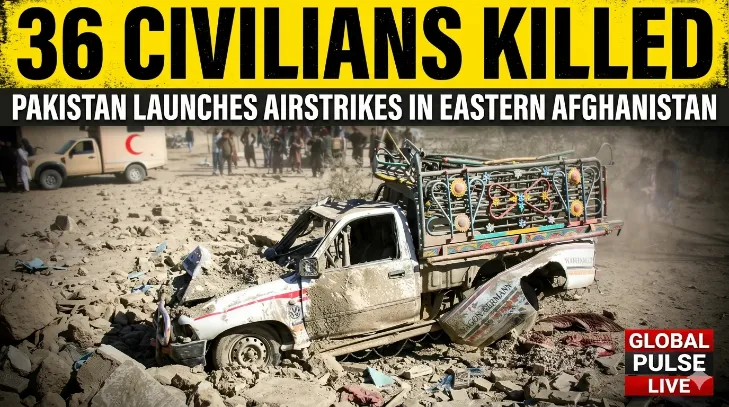
Kabul/Islamabad: Fresh tensions have erupted between Pakistan and Afghanistan after Pakistani airstrikes in three eastern Afghan provinces reportedly killed 36 civilians and injured 163 others, further straining relations between the neighbouring countries.
The Taliban-led Afghan government strongly condemned the attacks, describing them as a “cowardly act of aggression” and accusing Pakistan of violating its sovereignty. Deputy government spokespersons said the victims included civilians, while authorities warned that the strikes could further destabilise the already volatile border region.
Pakistan, however, defended the operation, saying it was a targeted mission against militant groups responsible for recent terrorist attacks inside the country.
Pakistan’s Information Minister Attaullah Tarar said security forces carried out an intelligence-based ground operation, followed by precision airstrikes along the Afghanistan-Pakistan border. According to Islamabad, the operation targeted hideouts of Jamaat-ul-Ahrar and Fitna al-Khawarij, the term Pakistan uses for the Tehreek-e-Taliban Pakistan (TTP).
The military action came just a day after militants attacked the regional headquarters of the Pakistan Rangers in Karachi, killing three security personnel. Pakistani forces later killed three attackers and captured another suspect, whom officials identified as an Afghan national.
The militant outfit Jamaat-ul-Ahrar, a breakaway faction of the Pakistani Taliban, claimed responsibility for the Karachi assault.
“Pakistan has always strived for maintaining peace and stability in the region, but the safety and security of our citizens remains our top priority,” Tarar said while defending the cross-border operation.
The Taliban administration in Kabul rejected Pakistan’s allegations that Afghan territory is being used as a sanctuary for militants. Taliban spokesperson Zabihullah Mujahid insisted that Afghanistan does not harbour terrorist organisations and accused Islamabad of targeting innocent civilians instead of militants.
Relations between the two neighbours have remained tense since the Taliban returned to power in Afghanistan in 2021. Although both sides agreed to a ceasefire in March following weeks of intense fighting earlier this year, sporadic cross-border clashes have continued.
Pakistan has witnessed a sharp rise in terrorist attacks over the past few years, particularly against its security forces. Islamabad blames the Tehreek-e-Taliban Pakistan (TTP) and allied militant groups for the violence, alleging that they operate from safe havens inside Afghanistan. The Taliban government has consistently denied those accusations.
The latest airstrikes also come as Pakistan plays a diplomatic role in efforts to ease tensions in the Middle East. Pakistani officials maintain that counter-terrorism operations along the Afghan border are essential to protecting national security.
Afghan authorities, however, argue that repeated Pakistani military operations have caused significant civilian casualties. They have previously accused Pakistan of carrying out indiscriminate attacks, including a strike on a drug rehabilitation centre earlier this year that the United Nations said resulted in hundreds of deaths.
The border conflict has already taken a heavy humanitarian toll. According to UN estimates, fighting since late February has claimed hundreds of lives and displaced tens of thousands of people. The conflict has included intense exchanges of fire along the frontier as well as unprecedented Pakistani airstrikes on major Afghan cities, including Kabul and Kandahar.
Diplomatic efforts by countries such as China and Saudi Arabia have so far failed to broker a lasting peace, while several border crossings remain either closed or operating under heavy restrictions.
With both governments standing firm on their positions, fears are growing that the latest escalation could further derail prospects for peace and plunge the region into another prolonged cycle of violence.