
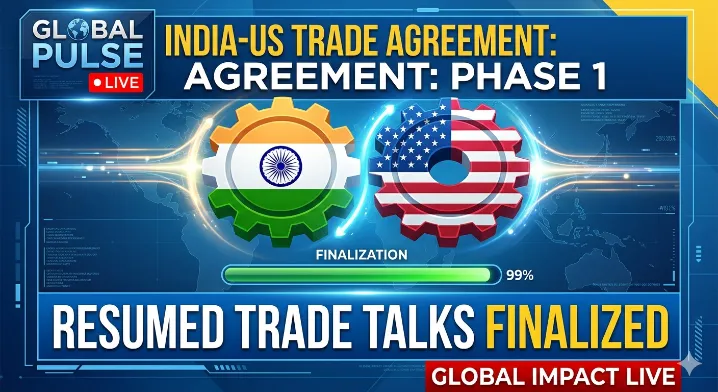
New Delhi: India and the United States on Tuesday began a fresh round of trade negotiations aimed at finalising the first phase of the long-awaited Bilateral Trade Agreement (BTA), a pact expected to significantly deepen economic engagement between the world’s largest and fifth-largest economies.
The three-day negotiations, scheduled from June 2 to June 4, will focus on finalising the legal text of the proposed interim agreement and resolving a handful of outstanding issues before the deal is formally signed.
Union Commerce and Industry Minister Piyush Goyal on Monday expressed confidence that the agreement is nearing completion, stating that nearly all substantive issues have already been settled.
“Mostly everything is finalised. As you know, the US side has said that 99 per cent of the issues have been resolved. Discussions are now focused on minor issues, commas and full stops,” Goyal told reporters.
He said the current discussions are largely centered on incorporating recent legal and policy changes in the United States into the final text of the agreement.
“Once these aspects are addressed, I am fully confident that India and the US will conclude the first tranche of the BTA as soon as possible, sign it, and move towards discussions on a more comprehensive trade agreement,” he said.
The US delegation is being led by chief negotiator Brendan Lynch, while India’s negotiating team is headed by Darpan Jain, Additional Secretary in the Department of Commerce.
According to the Commerce Ministry, the negotiations will cover key areas including market access, non-tariff barriers, customs and trade facilitation measures, investment promotion, and economic security cooperation.
The foundation for the agreement was laid earlier this year when both countries announced a framework for the first phase of the BTA. A joint statement issued in February outlined the contours of the interim trade arrangement and reaffirmed the commitment of both sides to broader trade negotiations.
However, developments in US trade policy have complicated the process. In February, the US Supreme Court struck down President Donald Trump’s reciprocal tariff measures imposed under the International Emergency Economic Powers Act (IEEPA). Subsequently, Washington announced a uniform 10 per cent tariff on imports from all countries for a 150-day period beginning February 24.
The policy changes prompted a reassessment of several aspects of the trade framework and led to the postponement of a scheduled meeting between chief negotiators earlier this year. Discussions resumed in Washington in April, paving the way for the current round of talks in New Delhi.
Trade experts believe the altered tariff environment may require both countries to recalibrate certain provisions of the agreement. With all major US trading partners now facing a uniform tariff regime, India is expected to seek preferential treatment that would provide a competitive advantage over rival exporters from Southeast Asia, Bangladesh, Pakistan and Sri Lanka.
Under the proposed framework, India has offered to eliminate or substantially reduce tariffs on a broad range of American industrial and agricultural products. These include animal feed ingredients, tree nuts, fruits, soybean oil, wine, spirits and several other commodities.
In return, the United States had earlier agreed to significantly reduce tariffs on Indian exports. The framework also envisages enhanced bilateral trade and investment flows across key sectors.
India has additionally indicated its intention to purchase nearly USD 500 billion worth of American goods over the next five years, including energy products, aircraft and aircraft components, technology products, precious metals and coking coal.
The negotiations are taking place against the backdrop of ongoing trade tensions between the two countries. The Office of the US Trade Representative (USTR) launched investigations earlier this year into alleged excess industrial capacity and labour-related concerns involving several countries, including India.
New Delhi has strongly rejected the allegations and formally challenged the basis of the investigations, arguing that the US has failed to provide sufficient evidence to justify the probes.
Despite these differences, both sides remain committed to expanding bilateral trade and investment ties. The United States remained India’s second-largest trading partner during the 2025-26 financial year.
India’s exports to the US rose marginally to USD 87.3 billion during the fiscal year, while imports from the US increased nearly 16 per cent to USD 52.9 billion. India’s trade surplus with the United States narrowed to USD 34.4 billion from USD 40.89 billion in the previous fiscal year.
The outcome of the ongoing negotiations is expected to play a crucial role in shaping the future trajectory of India-US economic relations and could lay the groundwork for a broader and more comprehensive trade pact in the coming years.