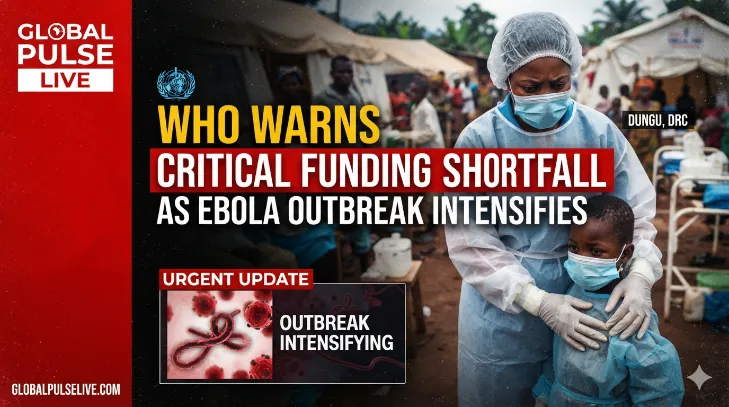

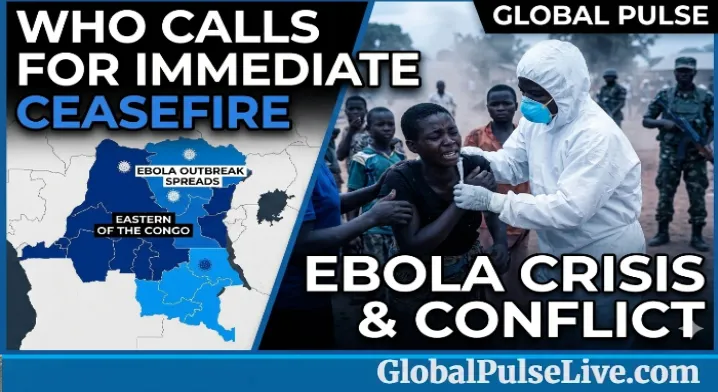
The head of the World Health Organization (WHO) has called for an immediate ceasefire in the eastern Democratic Republic of the Congo (DRC) as health officials struggle to contain a rapidly spreading Ebola outbreak complicated by ongoing armed conflict in the region.
WHO Director-General Tedros Adhanom Ghebreyesus warned that violence in eastern Congo was severely undermining efforts to control the outbreak, describing the situation as a “catastrophic collision of disease and conflict”.
“The Ebola outbreak in Ituri province is outpacing the response,” Tedros said in a social media post, adding that he plans to visit the DRC this week.
According to WHO data, the DRC had recorded 900 suspected Ebola cases and 223 suspected deaths as of Sunday. Uganda has confirmed seven Ebola cases and one death linked to the outbreak.
The outbreak was officially confirmed on May 15 in Ituri province, located in northeastern Congo near the borders with Uganda and South Sudan.
In response to the growing health emergency, Uganda announced Wednesday that it would close its border with the DRC for four weeks in an attempt to prevent further spread of the virus.
Senior Ugandan health official Diana Atwine said only Ebola response teams, humanitarian personnel, security operations, and cargo transport would be allowed to cross the border during the closure period.
Anyone granted permission to enter Uganda from the DRC would also be required to undergo a mandatory 21-day self-isolation period, she said.
The move comes despite earlier WHO recommendations advising countries not to close borders during Ebola outbreaks, warning that restrictions often drive people toward unofficial crossings that are harder to monitor.
Eastern Congo remains one of the most unstable regions in Africa, with numerous armed groups operating across Ituri, North Kivu and South Kivu provinces. The worsening security situation has displaced nearly one million people in Ituri alone, according to United Nations humanitarian agencies.
The outbreak has also spread into rebel-controlled areas of North and South Kivu, where the Rwanda-backed M23 rebel group controls large sections of territory.
Tedros stressed that humanitarian access is essential to stopping the spread of the virus.
“Stopping this Ebola transmission depends entirely on humanitarian access,” he said. “We cannot build community trust or isolate the sick while bombs are falling.”
Health workers have faced increasing dangers while attempting to track infections and treat patients. Attacks on medical facilities and mistrust among local communities have further complicated response efforts.
The situation escalated over the weekend when unidentified individuals attacked a hospital in Mongbwalu, in Ituri province. According to hospital director Dr. Richard Lokodu, several isolation tents were set on fire, allowing Ebola patients to flee the facility.
Lokodu said 18 patients escaped on Saturday, while seven more fled on Sunday. One person suspected of having Ebola reportedly died while trying to escape.
Health authorities say burial practices remain a major challenge in containing the disease. Families traditionally wash and touch the bodies of deceased relatives, but Ebola victims remain highly contagious after death, making funerals a significant source of transmission.
Aid organizations also warned that years of conflict and food insecurity have weakened local communities, especially children.
Philippe Guiton, country director for World Vision in the DRC, said widespread malnutrition had left many children particularly vulnerable to the virus.
“For children, the risks are especially acute,” Guiton said. “Years of conflict have weakened community systems, and acute malnutrition has left many young bodies too fragile to withstand a virus as aggressive as Ebola.”
In Uganda, the confirmed Ebola cases include healthcare workers, transport personnel, and Congolese nationals who crossed the border seeking treatment, according to WHO officials.
The outbreak is now raising fears of a broader regional health crisis if fighting and displacement continue to hamper containment efforts.