
India – Karnataka State – Bengalure: “By birth, I am an agriculturist. By profession, I am a businessman. By choice, I am an educationist. By passion, I am a politician.”
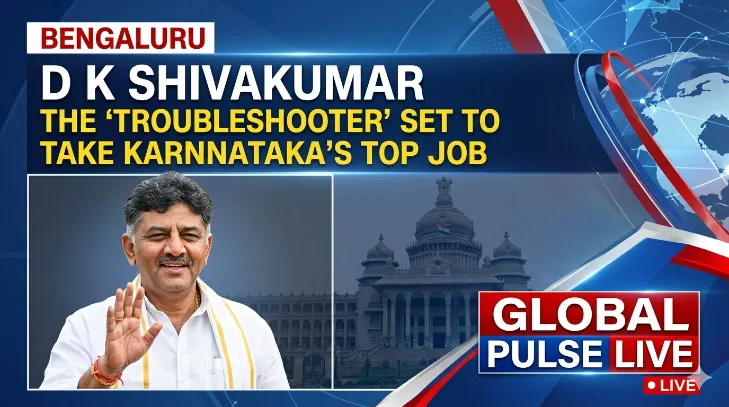
This is how Karnataka Chief Minister-designate D K Shivakumar often sums up his own identity — a self-description that blends politics, enterprise, and ambition in equal measure.
Now poised to take over as Chief Minister of Karnataka, Shivakumar’s rise marks the culmination of a decades-long political journey defined by organisational strength, controversy, loyalty to the Congress leadership, and a reputation for crisis management that extends far beyond the state.
From student leader to state power centre
Born in 1962 in a farming family, Shivakumar entered public life early through the NSUI, the student wing of the Indian National Congress. By 18, he had already emerged as an active student leader, and by his early 20s, he was seen as a rising force within the party’s Karnataka unit.
At 23, he contested his first major Assembly election from Sathanur (now Kanakapura), facing veteran leader H D Deve Gowda. Though he lost narrowly, the campaign established him as a serious political contender. He entered the Karnataka Legislative Assembly in 1989 and has remained a dominant figure in state politics since.
His early career also included allegations and associations that opponents have frequently used against him, including links during his student years that remain politically sensitive. Shivakumar has consistently dismissed such references as attempts to malign him.
Minister, organiser, power broker
Shivakumar’s administrative rise began in the early 1990s when he served as a minister in Karnataka. Over the years, he handled key portfolios including energy, urban development, and water resources.
His most politically influential phase came during the tenure of S M Krishna (1999–2004), when he was widely viewed within political circles as a powerful behind-the-scenes operator with influence across departments. Even critics acknowledged his ability to navigate bureaucracy and party structures with ease.
Within the Congress ecosystem, Shivakumar gradually became known less as a conventional minister and more as an organiser — someone tasked with solving problems, mobilising legislators, and managing political crises across states.
Wealth, business interests, and public perception
Beyond politics, Shivakumar has built a wide portfolio of business interests, including real estate, education, and infrastructure-linked ventures. According to his 2023 election affidavit, his declared assets exceed ₹1,400 crore, placing him among the wealthier politicians in the country.
His supporters describe him as a self-made entrepreneur-politician; critics argue that his business footprint raises questions about the overlap between politics and private enterprise. Shivakumar, however, has repeatedly maintained that his income sources are legitimate and transparent.
The Congress “crisis manager”
Shivakumar’s reputation as a troubleshooter for the party became prominent in the early 2000s and solidified over the following decade. He played key roles in safeguarding Congress legislators during periods of political instability, including operations involving legislators in Karnataka and other states.
His proximity to the central leadership, particularly figures like Sonia Gandhi and later Rahul Gandhi, strengthened his position within the party’s national structure. Within Congress circles, he is often described as the first call during a political crisis — whether involving legislative numbers, factional disputes, or electoral strategy.
His supporters cite his ability to deliver results under pressure. His critics argue that his methods are aggressive and politically hard-edged. Either way, his role in high-stakes political management has become central to his identity within the party.
Legal troubles and political resilience
Shivakumar’s career has also been marked by investigations by central agencies and legal disputes. He has consistently linked these actions to his political activities and his role in key Congress operations, particularly during Rajya Sabha elections in Gujarat in 2017, when Congress leaders were housed in Bengaluru to prevent political poaching.
He was later arrested and spent time in Tihar Jail, an episode that he describes as politically motivated. During this period, his stature within the Congress leadership appeared to deepen rather than weaken.
Rivalry with the Deve Gowda family
In Karnataka, one of Shivakumar’s most defining political rivalries has been with the family of H D Deve Gowda. The competition between the Congress and the Janata Dal (Secular) ecosystem has often played out through this personal and political rivalry.
Recent elections have seen alternating victories between the two sides, with shifting voter alignments, especially among the influential Vokkaliga community. Shivakumar’s influence in consolidating Congress support in several regions has been widely acknowledged, even by opponents.
Loyalty to the party high command
Despite political ambition and speculation about leadership aspirations, Shivakumar has consistently projected loyalty to the party’s central leadership. Even during coalition politics in Karnataka, he has publicly maintained discipline in line with decisions taken by the Congress high command.
Within the party structure, this loyalty has been one of his strongest assets, helping him maintain trust with both organisational leaders and the Gandhi family-led leadership.
The 2020 turning point
His appointment as Karnataka Pradesh Congress Committee president in 2020 marked a major shift in his career trajectory. He reorganised party structures, intensified outreach efforts, and played a visible role in major campaigns including the Bharat Jodo Yatra and state-level mobilisation drives.
His aggressive organisational push, combined with statewide political campaigning, is widely credited as one of the contributing factors to the Congress victory in the 2023 Karnataka Assembly elections.
A leader shaped by contradiction
Shivakumar’s personal profile blends multiple identities — farmer background, businessman, educationist, and long-time political operator. He is also known for his religious practices, temple visits, and interest in astrology, which he often references in public life.
At the same time, he has cultivated a reputation for sharp political messaging, including punchy one-liners that reflect his combative style.
What lies ahead
As D K Shivakumar prepares to assume the Chief Minister’s office, expectations are high within the Congress and beyond. His supporters see him as a decisive administrator capable of managing both political and governance challenges. His critics view him as a powerful but polarising figure.
Whether he can translate his long-standing reputation as an organiser and crisis manager into stable governance will now define the next phase of his political career.
For a leader who has spent decades navigating both opportunity and controversy, the transition from strategist to chief executive is the most significant test yet.