
Ukraine’s military has outlined a range of long-range aerial systems used in recent strikes on targets inside Russia’s Moscow region, marking one of the most extensive reported drone operations against the Russian capital area since the start of the war.
The General Staff of the Armed Forces of Ukraine said the weekend operation involved multiple systems, including the RS-1 “Bars” jet-powered unmanned aerial vehicle, the Firepoint FP-1 winged drone, and a previously unreported platform referred to as the “Bars-SM Gladiator,” which analysts say has not been publicly documented before.
The strikes form part of a broader escalation in Ukraine’s campaign targeting military and industrial infrastructure deep inside Russian territory.
Ukraine’s Security Service (SBU) said one of the primary targets was the Angstrom plant in Zelenograd, in the Moscow region, which produces microelectronics and components used in precision weapons systems.
According to the SBU, a fire broke out at the facility following the strike. The agency described the plant as a key element of Russia’s military-industrial supply chain, involved in producing microchips, radio electronics, optical systems and robotics.
The SBU also reported a strike on the Solnechnogorskaya pumping station, a facility linked to the Moscow ring oil pipeline system used for the storage and transport of gasoline and diesel fuel, including supplies intended for military use. Fires were reported at the site.
“These strikes reduce the enemy’s ability to continue its war,” the SBU said.
Russian authorities confirmed that several locations had come under attack and reported at least four deaths and more than a dozen injuries. Officials often attribute such incidents to “falling drone debris,” a description Ukraine and independent analysts have previously questioned.
Russia’s defence ministry said it had intercepted a large number of incoming drones, claiming that more than 3,100 Ukrainian drones were shot down over the previous week.
Independent verification of battlefield claims from both sides remains difficult due to restricted access to affected areas.
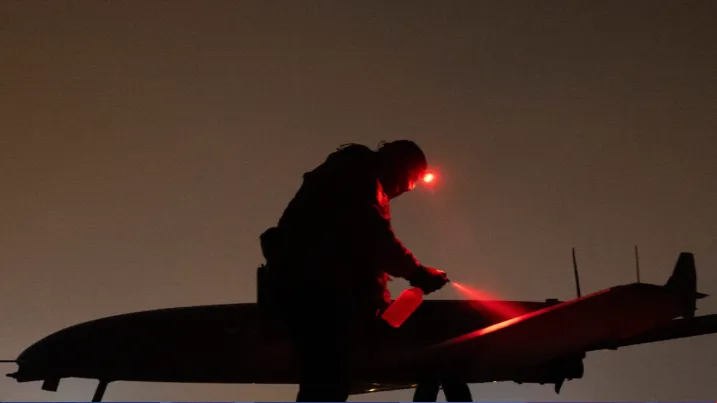
A report by Agence France-Presse said journalists were taken to an undisclosed Ukrainian launch site where long-range drones were prepared before being launched toward Russian territory. The drones reportedly took off using rocket-assisted boosters, leaving visible trails as they headed toward their targets.
Ukrainian President Volodymyr Zelenskyy defended the expanding cross-border operations, saying they were “entirely justified” in the context of Russia’s continued invasion.
He also claimed that Ukrainian forces had achieved a shift in battlefield momentum, stating that Ukrainian combat operations were now outnumbering Russian ones in some sectors.
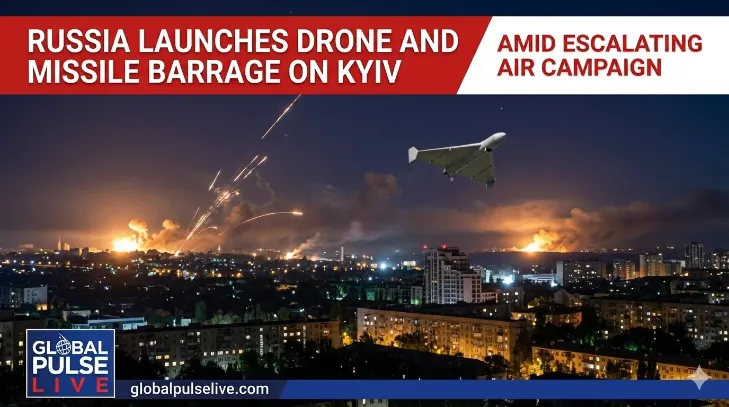
While Ukraine intensified strikes inside Russia, Russian forces continued their own aerial assaults on Ukrainian cities.
Officials in Ukraine reported drone and missile attacks on Odesa and Dnipro overnight. In Odesa, residential buildings, a school, and a kindergarten were damaged, injuring an 11-year-old boy and a 59-year-old man, according to regional authorities. In Dnipro, missile strikes injured three people.
Additional attacks were reported in the Zaporizhzhia and Kherson regions, where civilian casualties included both injuries and at least one death following drone-dropped explosives.
The conflict’s geographic spread has also raised concerns among NATO members. A suspected Ukrainian military drone was recovered after crashing in Lithuania, while Latvian authorities reported temporary airspace alerts and the brief entry of a drone into its territory.
Officials in Lithuania said the recovered drone was unarmed and had not been detected upon entry. Latvia has seen repeated airspace alerts in recent months linked to drones crossing from the direction of Russia or Belarus.
Ukraine has previously said some drones may stray off course due to Russian electronic warfare measures.
Meanwhile, Ukraine’s drone command leadership has defended the expansion of long-range strikes into Russian territory, arguing that infrastructure supporting Moscow’s war effort should be considered legitimate military targets.
As both sides increase the scale and reach of aerial operations, the war continues to expand beyond traditional frontlines, with deeper strikes inside Russia and intensified attacks on Ukrainian cities highlighting the growing role of drone warfare in the conflict.