
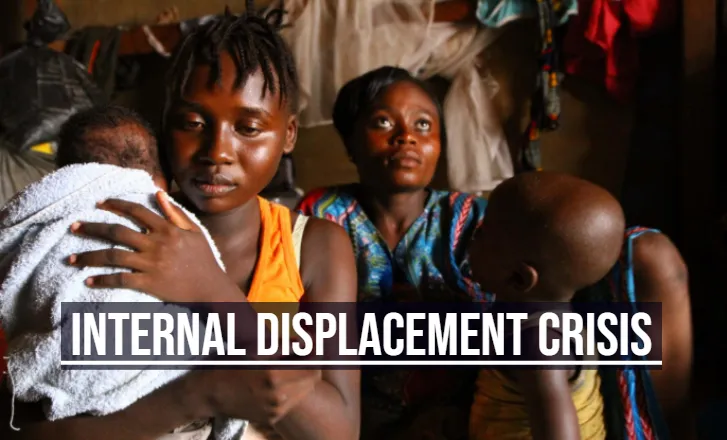
Global internal displacement caused by conflict and violence has reached its highest level on record in 2025, surpassing displacement driven by natural disasters for the first time since monitoring began, according to a new report by the Internal Displacement Monitoring Centre (IDMC).
The report shows that 32.3 million internal displacements were triggered by conflict and violence in 2025 — a 60% increase compared with the previous year. In contrast, disaster-related internal displacements stood at 29.9 million, marking the first time conflict has become the dominant driver of internal displacement in the annual data set.
Jan Egeland, secretary general of the Norwegian Refugee Council, described the findings as evidence of a “global collapse” in the protection of civilians.
“Countless families are returning to destroyed homes and disappearing services – or cannot return at all,” Egeland said. “From DR Congo and Sudan to Iran and Lebanon, we see millions more displaced on top of previous record numbers driven out of their homes.”
Internal displacement refers to each instance in which a person is forced to flee within their own country. The same individual may be displaced multiple times, meaning movement figures can exceed the number of affected people.
Total displaced population remains historically high
The IDMC’s Global Report on Internal Displacement estimates that 82.2 million people remained internally displaced in 2025, the second-highest level ever recorded after a peak of 83.5 million in 2024. It also marks the first recorded decline in the overall displaced population in two decades of data collection.
Despite the slight drop, the report cautions against interpreting the trend as progress. It attributes the decrease largely to partial returns in countries such as Sudan, the Democratic Republic of the Congo, and Syria, as well as gaps in data availability.
“The decline in the number should not be mistaken for progress,” the report states, warning that many returns occur in unsafe conditions, with damaged infrastructure and limited access to essential services.
Conflict increasingly dominant driver of displacement
More than 83% of internal displacements in 2025 were caused by conflict and violence, with the remainder linked to natural disasters.
Nearly half of all conflict-related displacement occurred in Sudan, Colombia, Syria, Yemen, and Afghanistan. Sudan has remained the world’s largest internal displacement crisis for the third consecutive year.
The report also highlights a growing role of international armed conflicts, which accounted for 46% of conflict-related displacement events in 2025 — nearly double the figure recorded the previous year.
Iran and the Democratic Republic of the Congo together accounted for roughly two-thirds of all conflict-driven internal displacements during the year, underscoring the widening geographic spread of instability.
Repeated displacement and strained protection systems
The IDMC emphasizes that many individuals are not displaced once but multiple times as conflicts shift or intensify, often preventing long-term recovery or return.
Tracy Lucas, director of the IDMC, said the scale and repetition of displacement reflect systemic failures in protection mechanisms.
“When you’re talking about the displacements themselves – the movements of people – we have to recognise that in some cases, people are continually displaced,” Lucas said. “They’re not just displaced once, they could be displaced two or three times … Yet the systems meant to protect them are being dismantled.”
Humanitarian organizations warn that repeated displacement cycles are deepening vulnerability, eroding livelihoods, and increasing pressure on already strained aid systems.
A worsening global trend
While the slight reduction in the total number of displaced people offers a limited statistical shift, researchers stress that underlying conditions remain severe, with ongoing conflicts and climate-related disasters continuing to drive mass movement worldwide.
Aid agencies say the findings highlight an urgent need for sustained international support, stronger civilian protection mechanisms, and long-term solutions for populations caught in recurring cycles of displacement.