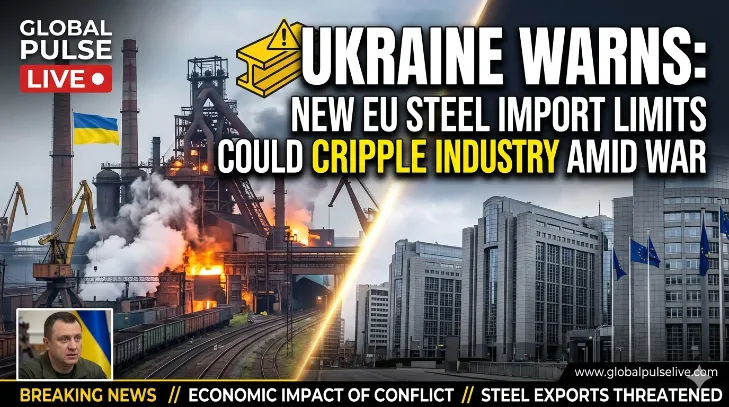
Kyiv: Ukraine’s steel industry could face severe economic consequences under new European Union restrictions on steel imports, with the head of the country’s largest steel producer warning that the measures may devastate one of Ukraine’s most important industries during its ongoing war with Russia.
Yuriy Ryzhenkov, Chief Executive Officer of Metinvest, Ukraine’s largest steelmaker, said the EU’s revised steel import quota system, scheduled to take effect on July 1, could have a devastating impact on Ukrainian producers.
“The new rules could effectively kill the Ukrainian steel industry,” Ryzhenkov warned, criticizing the measures as unfair given Ukraine’s current wartime challenges.
The European Union recently announced stricter safeguards for its steel market in response to a long-standing global oversupply of steel, largely attributed to Chinese production. Under the new framework, tariff-free steel import quotas will be reduced by half, while tariffs on imports exceeding allocated quotas will rise from 25 percent to 50 percent.
The changes have prompted intense negotiations among steel-exporting nations seeking to secure adequate access to the EU market. Similar concerns have been raised by the United Kingdom’s steel sector, which has described the restrictions as a potential threat to its future competitiveness.
For Ukraine, however, the stakes are particularly high. Since Russia’s full-scale invasion in February 2022, the country’s steel industry has lost access to several traditional export markets and has increasingly relied on Europe as a key destination for its products.
Ryzhenkov argued that Ukrainian steel exports pose little risk to European producers due to the relatively modest size of Ukraine’s industry. He said imposing harsh restrictions on one of the few sectors still operating effectively during wartime could significantly undermine Ukraine’s economy.
Industry leaders also warn that reduced steel exports would lead to a substantial decline in tax revenues, depriving the Ukrainian government of hundreds of millions of dollars needed to support defense and public services. Metinvest is widely regarded as one of Ukraine’s largest private-sector taxpayers.
The sector is already facing numerous challenges linked to the war. Russian attacks on critical infrastructure have disrupted rail transport, damaged power facilities, and increased operating costs for manufacturers. Steel plants have been forced to rely on backup generators to maintain production during frequent electricity outages.
Metinvest’s remaining steel plants near Zaporizhzhia and Kamianske continue to operate below full capacity, while the company has suffered major losses since the start of the conflict. Its flagship steelworks in Mariupol was completely destroyed during intense fighting early in the war, and its coking coal mine in Pokrovsk has been affected by ongoing military operations.
Adding further pressure, Ukrainian steel producers must also prepare for the European Union’s Carbon Border Adjustment Mechanism (CBAM), which imposes additional costs on imports produced using higher-emission technologies.
Ryzhenkov noted that although Metinvest had planned significant investments to modernize its facilities and transition to cleaner steel production methods before the war, the current security situation makes such investments impossible.
As Ukraine continues to defend itself against Russia’s invasion, industry leaders are urging the European Union to reconsider its approach and provide greater flexibility for Ukrainian steel exports, arguing that economic resilience remains crucial to the country’s wartime survival.