
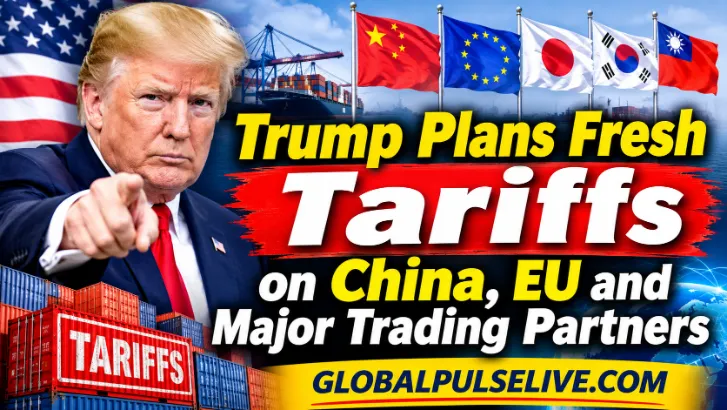
The administration of U.S. President Donald Trump is preparing a fresh round of tariffs targeting imports from China and several of America’s largest trading partners, marking another major escalation in its “America First” trade agenda.
According to senior administration officials, the proposal includes an additional 20% tariff on Chinese goods, while new import duties ranging from 10% to 18% are planned for products from the European Union, Japan, South Korea, Taiwan, India, Brazil, Vietnam, Bangladesh, Cambodia, Indonesia, Malaysia, Singapore, Switzerland, and Thailand. Mexico and Norway remain under separate trade investigations.
The proposed measures are intended to counter what the administration describes as unfair trade practices, including government subsidies, excessive industrial production, and trade barriers that allegedly disadvantage American manufacturers. Officials argue that these policies have contributed to a U.S. goods trade deficit exceeding $1 trillion annually.
The tariff proposals come after the U.S. Supreme Court ruled earlier this year that the president could not use emergency powers to impose broad-based tariffs without congressional approval. As a result, the administration is relying on Section 301 of the Trade Act of 1974, which allows the United States to investigate and respond to unfair foreign trade practices.
A senior administration official, speaking on condition of anonymity before the release of official reports by the U.S. Trade Representative (USTR), emphasized that the tariffs remain in the proposal stage and that no final implementation timeline has been established.
China and Brazil Face the Strongest Measures
China is expected to bear the heaviest impact, with the proposed 20% tariff being added to existing duties on certain products, pushing total tariff rates on some Chinese imports to 45%.
Vietnam could also face a 20% tariff, pending the outcome of ongoing trade negotiations.
Brazil has been singled out for additional penalties after bilateral trade discussions reportedly stalled. The U.S. is proposing higher import taxes on raw and refined sugar, along with a new 10% tariff on aircraft, a move expected to significantly affect Brazilian aerospace manufacturer Embraer.
Trade Truce with China Unlikely to Collapse
Despite the tougher stance, U.S. officials said the new tariffs are not expected to derail the trade truce reached between Washington and Beijing last year, which is scheduled to expire on January 10.
President Trump recently met Chinese President Xi Jinping in Shenzhen and is expected to host him at next month’s G20 Summit in Florida, where both leaders are likely to revisit trade issues, including rare earth mineral exports and China’s purchases of American agricultural products.
China reiterated its opposition to the planned tariffs. Foreign Ministry spokesperson Guo Jiakun stated that “a tariff war or a trade war serves no party’s interests,” while rejecting U.S. allegations of industrial overcapacity as politically motivated.
Existing Auto and Steel Tariffs Unaffected
Administration officials clarified that the proposed tariffs would apply only to specific products and would not be added on top of existing tariffs imposed on automobiles, steel, aluminum, and other goods under Section 232 of the Trade Expansion Act of 1962.
Likewise, the new duties would not overlap with tariffs announced earlier this year on imports from countries accused of failing to prevent the use of forced labor in supply chains.
Political and Economic Debate Continues
The tariff proposal arrives at a politically sensitive moment following Republican setbacks in the recent U.S. midterm elections, where many voters expressed dissatisfaction with the country’s economic direction.
President Trump continues to argue that higher import taxes will revive domestic manufacturing, create American jobs, and reduce the federal budget deficit. However, critics warn that additional tariffs could increase consumer prices, fuel inflation, and place further strain on global trade relationships.
The administration’s investigation reports are expected to provide further details before any final decisions on implementation are made.