
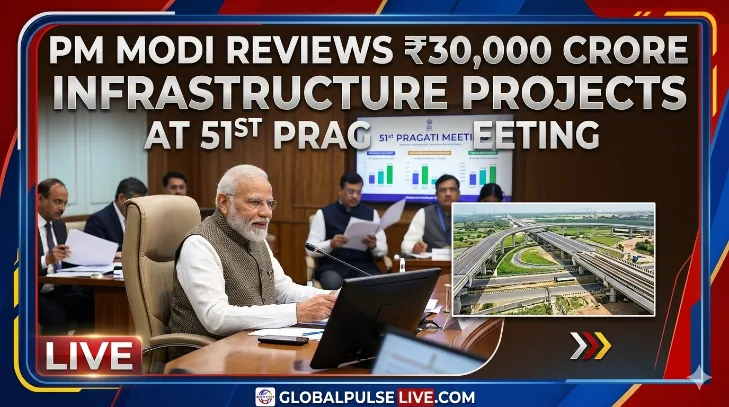
India – New Delhi: Prime Minister Narendra Modi on Wednesday chaired the 51st meeting of PRAGATI (Pro-Active Governance and Timely Implementation), reviewing major infrastructure projects across multiple sectors and stressing faster execution, better coordination, and time-bound delivery of public works.
The meeting, held at Seva Teerth, focused on seven key infrastructure projects worth approximately ₹30,000 crore spanning the railways, power, and road sectors across nine states. The Prime Minister also reviewed the Ken-Betwa River Link Project and the Swachh Bharat Mission–Urban 2.0.
PRAGATI is an ICT-enabled governance platform designed to bring together the Centre and state governments to resolve bottlenecks and accelerate implementation of major public projects.
During the review of power sector initiatives, the Prime Minister called for a mission-mode expansion of rooftop solar installations in urban areas, including residential colonies, cities, and public institutions. He said the initiative could reduce electricity costs, strengthen energy security, and support India’s clean energy transition.
While assessing road and port connectivity projects, Modi emphasized that the upcoming Vadhavan Port should be developed as a model of integrated, multi-modal infrastructure. He said the port should not function in isolation but as a “national gateway” linked with coastal shipping, inland waterways, dedicated freight corridors, highways, railways, and airports to build a future-ready logistics network.
The Prime Minister also reviewed the Swachh Bharat Mission–Urban 2.0, stressing that the programme must go beyond infrastructure creation to deliver measurable outcomes. He urged states to speed up solid waste management systems, including waste processing facilities and GOBARdhan plants, and to ensure greater citizen participation and monitoring.
Reviewing the Ken-Betwa River Linking Project, Modi described it as a model for inter-state cooperation in addressing water scarcity. He encouraged states to adopt similar integrated approaches to river linking, groundwater recharge, irrigation efficiency, and water conservation to ensure long-term water security.
He also highlighted the need for timely completion of public projects, warning that delays not only increase costs but also deprive citizens of essential services and development benefits.
“Every delay has a direct impact on people’s lives, regional growth and public resources,” the Prime Minister said, urging ministries and states to adopt a proactive, time-bound approach to remove bottlenecks and speed up execution.
The Prime Minister further suggested innovative use of canal infrastructure, including installing solar panels over canals to generate renewable energy while reducing evaporation losses and optimizing land use.
The meeting reaffirmed the government’s focus on infrastructure-led growth, clean energy expansion, and improved coordination between central and state agencies to accelerate national development goals.