New Delhi: The Quad grouping comprising India, the United States, Japan and Australia has announced the launch of a new Quad Fuel Security Forum, signalling a major expansion of the bloc’s strategic focus from maritime security and supply-chain resilience into the increasingly critical arena of energy security and geopolitics.
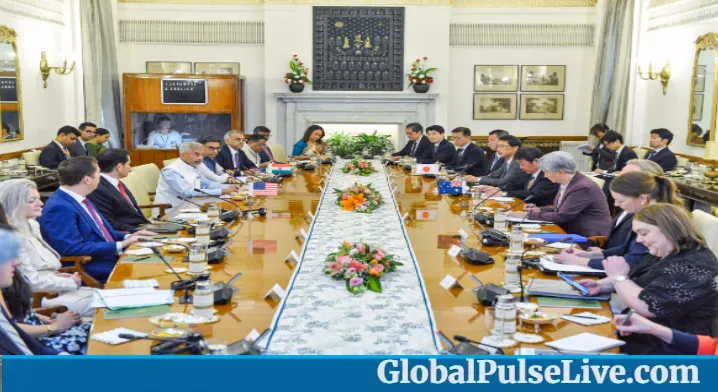
The initiative was unveiled following the Quad Foreign Ministers’ Meeting held in New Delhi on Tuesday, attended by External Affairs Minister S. Jaishankar, US Secretary of State Marco Rubio, Australian Foreign Minister Penny Wong and Japanese Foreign Minister Toshimitsu Motegi.
In a joint statement on Indo-Pacific energy security, the four countries stressed their commitment to ensuring stable and resilient energy systems amid growing geopolitical instability and disruptions to global trade routes.
“India, Australia, Japan and the United States of America are united by a common vision for a free and open Indo-Pacific, underpinned by robust economic and energy systems,” the statement said.
Focus on Energy Stability
The Quad countries acknowledged that disruptions in global oil, gas and petrochemical markets are disproportionately affecting Indo-Pacific nations, many of which remain heavily dependent on imported energy.
The statement noted that the grouping would convene a Quad Fuel Security Forum to facilitate high-level discussions and strengthen coordination on energy resilience, supply-chain diversification and emergency response mechanisms.
The four nations also reaffirmed their commitment to maintaining “well-functioning, stable, transparent, secure and resilient energy markets” while emphasising the importance of uninterrupted trade flows and secure maritime routes.
Particular attention was drawn to the Strait of Hormuz, one of the world’s most important energy chokepoints through which nearly 20 percent of global oil trade passes.
The Quad reiterated the need to ensure freedom of navigation and uninterrupted commercial shipping, warning against measures that could disrupt maritime trade.
Rising Concerns Over Maritime Disruptions
The initiative comes amid continuing instability in West Asia and attacks on commercial shipping in the Red Sea region since late 2023. These attacks have forced global shipping companies to reroute cargo vessels around the Cape of Good Hope, sharply increasing transport costs, insurance premiums and delivery timelines.
For energy-import dependent economies in the Indo-Pacific, the disruptions have translated into higher fuel prices, inflationary pressures and concerns over food and fertiliser security.
Addressing a media briefing after the meeting, K Nagaraj Naidu, Additional Secretary in the Ministry of External Affairs, said the Quad Initiative on Indo-Pacific Energy Security aims to combine the technological, logistical and analytical strengths of member nations.
“The idea is to come up with an engagement plan focusing on technology, management, international market analysis and emergency response,” he said.
Naidu added that discussions also focused on ensuring affordable and reliable energy supplies for populous nations such as India.
Strategic and Geopolitical Dimensions
Analysts believe the new forum reflects the Quad’s growing recognition that energy security, economic resilience and strategic stability are now deeply interconnected.
The initiative is also being viewed against the backdrop of the Russia-Ukraine conflict, which exposed vulnerabilities in global energy systems and highlighted how energy exports can become geopolitical tools.
For countries such as India and Japan, diversifying suppliers and transit routes has become a strategic imperative.
Although China was not directly mentioned in the statement, experts say the move carries significant geopolitical implications.
Beijing currently dominates several sectors critical to the global energy transition, including rare earth processing, battery manufacturing and clean-energy supply chains. China’s expanding maritime presence in the South China Sea and Indian Ocean has also heightened concerns among Quad members over sea-lane security.
By institutionalising cooperation on fuel security, the Quad is signalling its intention to build alternative frameworks that reduce dependence on any single supplier or geopolitical bloc.
Message to the Indo-Pacific
According to K Yhome, a Fellow at the Shillong-based Asian Confluence think tank, the initiative reflects increasing concern among Indo-Pacific countries over the vulnerability of energy supply routes.
“With the ongoing tensions involving Iran and concerns over the Strait of Hormuz, there is growing recognition that Indo-Pacific countries need resilient energy supply chains,” Yhome said.
He noted that India, Japan and Australia are all heavily dependent on energy shipments passing through the Strait of Hormuz, making maritime stability a strategic necessity.
Yhome added that the new initiative also sends a message to regional countries that the Quad is prepared to play a more active role in ensuring regional stability and supporting partner nations during crises.
“The statement is also a message to China that Quad countries can build alternative energy supply frameworks and strategic partnerships,” he said.
Quad Expands Strategic Scope
The proposed Quad Fuel Security Forum marks a significant evolution in the grouping’s agenda, moving beyond traditional security concerns toward broader geo-economic coordination.
Experts say the initiative demonstrates how the Quad is increasingly positioning itself as a multidimensional strategic framework capable of addressing emerging challenges ranging from maritime security to energy resilience and supply-chain stability in the Indo-Pacific region.