
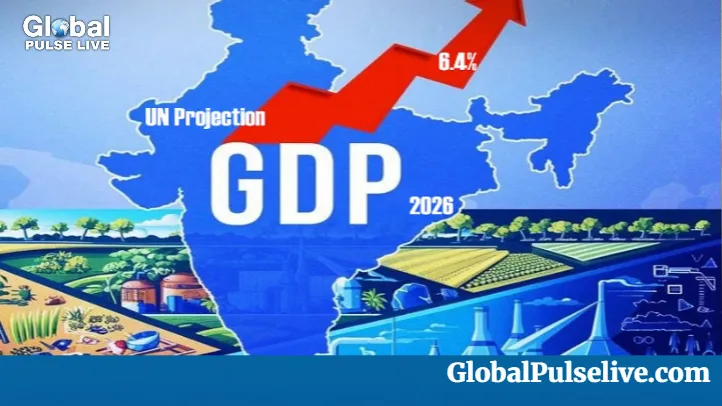
United Nations: The United Nations has lowered India’s economic growth forecast for 2026 to 6.4 per cent from its earlier estimate of 6.6 per cent, citing rising global uncertainties and economic disruptions linked to the ongoing West Asia crisis.
The revised projection was released on Tuesday in a report by the United Nations Department of Economic and Social Affairs (UN DESA), which warned that geopolitical tensions in West Asia are creating fresh challenges for the global economy by slowing growth, increasing inflationary pressures and deepening uncertainty.
Despite the downgrade, the report said India is expected to remain one of the world’s fastest-growing major economies.
According to Ingo Pitterle, Senior Economist and Officer-in-Charge of the Global Economic Monitoring Branch at UN DESA, India is “not immune” to the current global economic challenges.
He noted that India’s dependence on energy imports exposes it to risks arising from rising crude oil prices and disruptions in global supply chains. He also highlighted vulnerabilities linked to remittances and tighter global financial conditions.
“The West Asia shock is lowering growth while at the same time pushing up inflation, thereby constraining policy space,” Pitterle said, adding that the situation could complicate monetary and fiscal policy decisions for Indian authorities.
The report pointed out that India’s economic growth is expected to moderate from 7.5 per cent in 2025 to 6.4 per cent in 2026, largely due to higher energy import costs and tightening financial conditions.
However, UN economists maintained that the country’s long-term growth fundamentals remain strong. Robust domestic consumption, public investment and continued expansion in services exports are expected to support economic activity.
“We have seen structurally very robust growth in India, driven by consumer demand, public investment and strong services exports. These drivers will largely remain intact,” Pitterle said in response to a question by PTI.
The report also projected that India’s economy could rebound slightly to 6.6 per cent growth in 2027.
Shantanu Mukherjee, Director of the Economic Analysis and Policy Division at UN DESA, said countries dependent on exports could face additional challenges if rising import costs begin affecting manufacturing and logistics expenses.
He explained that increasing freight charges, fuel costs and industrial input prices could gradually raise operational costs for businesses and impact export competitiveness.
“Like many other large economies, India still has some policy space to manage these shocks,” Mukherjee said, stressing the importance of maintaining fiscal buffers and managing inventories efficiently during periods of global volatility.
The report also revised the global economic outlook downward, forecasting world GDP growth at 2.5 per cent in 2026 — 0.2 percentage points lower than its January estimate and significantly below pre-pandemic averages.
Analysts say the latest UN assessment reflects growing concern over the broader economic impact of geopolitical tensions, rising commodity prices and tighter financial conditions across major economies.