
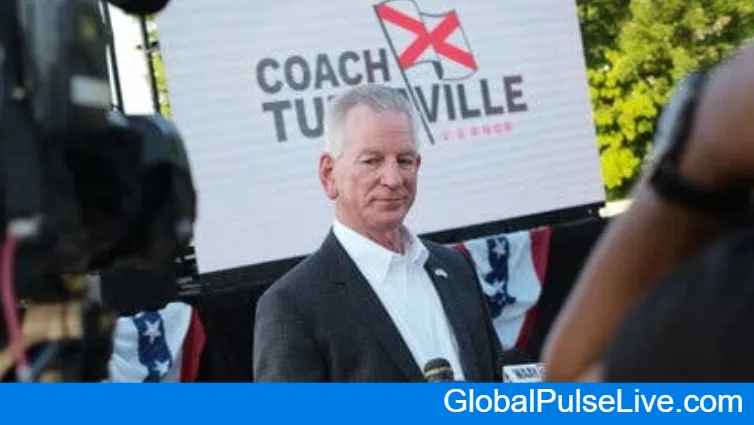
Montgomery, Alabama, United States — Alabama is heading toward a high-profile political rematch after Republican U.S. Senator Tommy Tuberville and former Democratic Senator Doug Jones each won their respective primaries for governor on Tuesday, setting up a renewed contest between two familiar rivals.
The result revives a political matchup last seen when Tuberville defeated Jones in a previous statewide race, reshaping Alabama’s Senate representation and underscoring the state’s deep Republican leanings.
Jones, who briefly served in the U.S. Senate following a surprise 2017 special election victory, is now positioning his campaign around issues such as healthcare expansion, wage growth, and the rising cost of living. Speaking to supporters, he called for expanding Medicaid and raising the minimum wage, arguing that Alabama needs structural change in how government serves residents.
“Change means rising wages, including raising the minimum wage,” Jones said. “Change means expanding Medicaid to make healthcare affordable. Change means better jobs.”
Tuberville, a former college football coach, framed the election in ideological terms, casting his campaign as a fight against what he described as left-leaning policies.
“I’m not running against him,” Tuberville said. “I’m running against socialism and communism.”
The Republican senator’s entry into the governor’s race has also reshaped Alabama’s Senate landscape, triggering a competitive primary battle for his vacated seat. That race will head to a runoff election scheduled for June 16, with both parties still working through crowded fields.
On the Republican side, U.S. Representative Barry Moore advanced to the runoff after campaigning as a staunch conservative aligned with former President Donald Trump, who publicly endorsed him. Moore, a member of the House Freedom Caucus, has pitched himself as a “Trump conservative” ready to push a hardline agenda in Washington.
Alabama Attorney General Steve Marshall and former Navy SEAL Jared Hudson are also competing for the remaining Republican runoff spot, while Democrats Dakarai Larriett and Everett Wess are set for their own primary runoff in a state where the party faces long odds in statewide races.
The election cycle has been further complicated by an ongoing redistricting dispute following a recent U.S. Supreme Court decision that weakened parts of the Voting Rights Act. State officials have said new congressional primaries may be held in August under revised maps, creating confusion among voters about which results will ultimately stand.
Nearly 24,000 voters have already been affected by overlapping election schedules and changing district lines, with officials confirming that results in several congressional districts may be voided and re-run under the new boundaries.
Despite the uncertainty, both parties are preparing for an intense summer of campaigning ahead of runoff elections and potential redraw-driven primaries that could reshape Alabama’s political map ahead of the November general election.