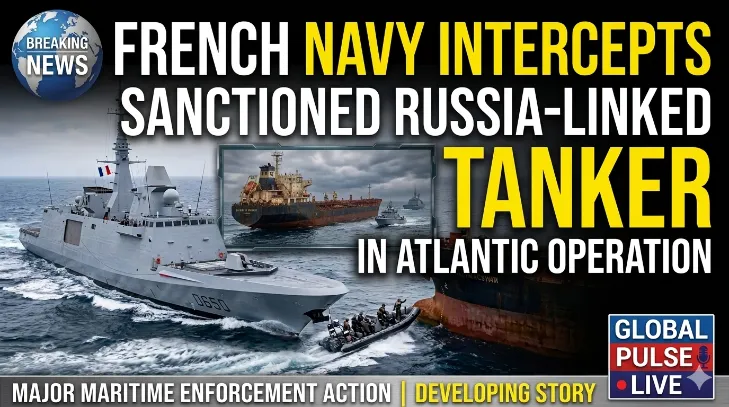
PARIS — The French Navy has intercepted and boarded a Russia-linked oil tanker in the Atlantic Ocean as part of an international effort to enforce sanctions against Moscow and curb the activities of vessels suspected of belonging to Russia’s so-called “shadow fleet.”
French President Emmanuel Macron announced that naval forces boarded the tanker, identified as Tagor, on Sunday while it was sailing from Russia. According to French authorities, the operation was conducted in international waters and received support from several allied countries, including the United Kingdom.
“This operation took place in the Atlantic Ocean, on the high seas, with the support of several partners, including the United Kingdom, in strict compliance with the law of the sea,” Macron said.
French officials stated that the vessel was suspected of violating international sanctions and operating under irregular maritime documentation. Authorities said the tanker was more than 400 nautical miles west of Brittany when French naval forces carried out the inspection.
Suspected False Flag Registration
According to the Maritime Prefecture of the Atlantic, the operation was launched after concerns emerged regarding the vessel’s nationality and registration status. Investigators suspected the tanker was sailing under a false flag, a practice often associated with attempts to conceal ownership and evade international sanctions.
After boarding the vessel, inspection teams examined its documents and reportedly confirmed irregularities in the ship’s registration. French authorities subsequently ordered the tanker to be diverted under the supervision of judicial authorities for further investigation.
The prefecture did not officially identify the vessel in its statement, though Macron referred to it as the Tagor.
Part of Wider Crackdown on Russia’s “Shadow Fleet”
The interception forms part of a broader Western campaign targeting Russia’s “shadow fleet” — a network of aging tankers and cargo vessels allegedly used to transport Russian oil outside traditional Western shipping, insurance, and regulatory systems.
Western governments argue that these vessels help Moscow maintain oil exports despite sanctions imposed after Russia’s invasion of Ukraine. The European Union, the United Kingdom, and allied nations have repeatedly expanded sanctions aimed at reducing Russian energy revenues.
French officials contend that profits generated through such operations contribute to financing Russia’s military campaign in Ukraine, which is now in its fifth year.
Environmental and Maritime Safety Concerns
Beyond sanctions enforcement, European authorities have increasingly expressed concern about the environmental and navigational risks posed by shadow fleet vessels.
Many of the ships are believed to operate with opaque ownership structures, non-standard insurance arrangements, and questionable safety certifications. Maritime experts have warned that older tankers operating outside established regulatory frameworks may be more vulnerable to accidents, mechanical failures, and oil spills.
French authorities said vessels that fail to comply with international maritime standards present risks not only to coastal environments but also to global shipping routes and maritime safety.
Growing French and British Cooperation
The latest operation reflects growing cooperation between France and the United Kingdom in monitoring and disrupting vessels suspected of sanctions evasion.
Earlier this year, France conducted several similar operations involving tankers linked to Russia. In January, French forces intercepted a vessel known as Grinch in the western Mediterranean after it departed from Murmansk, Russia. In March, French authorities seized another tanker, Deyna, also suspected of operating within the shadow fleet network.
British authorities have likewise increased surveillance and enforcement measures against sanctioned vessels passing through European waters.
Investigation Continues
French prosecutors are expected to oversee the next phase of the investigation into the Tagor’s registration status, ownership structure, and compliance with international maritime law.
No immediate response was reported from Russian officials regarding the latest interception. Moscow has previously criticized Western actions against vessels linked to Russian oil exports, arguing that such operations interfere with lawful maritime commerce.
The incident is likely to further increase tensions between Russia and Western governments as sanctions enforcement efforts expand across European and international waters.